
Dynamic & Modifiable Illustration of a Theorem Involving 2 Intersecting Circles
Loading the math board and drawing, please wait…
In collections
Circles (Theorems)
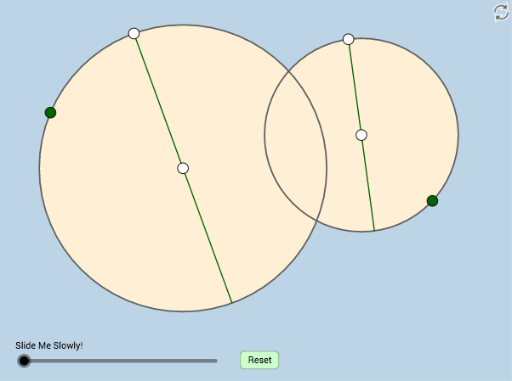
This GeoGebra example dynamically illustrates a geometric theorem involving two intersecting circles, inspired by a tweet from Antonio Gutierrez. It allows users to drag points and adjust sliders to explore relationships among intersection points, segments, and angles. The core mathematical concepts include circles, intersecting chords, similar triangles, and distance measurement. The construction uses GeoGebra commands such as Circle, Segment, PointIn, Distance, Intersect, CircleArc, Point, Line, Dilate, and Midpoint, creating multiple circles, segments, intersection points, arcs, and midpoints, with dilations and midpoints used to generate auxiliary elements. This resource is ideal for middle and high school geometry classes, teacher demonstrations, or student self-study, fostering understanding of circle-triangle relationships and dynamic geometric reasoning.
GeoGebra Commands & Parameters
Circle(A, B) → cSegment(A, B) → fPointIn(a) → CDistance(C, c) → bPointIn(d) → DCircle(C, D) → eIntersect(c, e, 1) → EIntersect(c, e, 2) → FCircleArc(C, F, E) → gCircleArc(C, E, F) → hPoint(g) → GLine(G, C) → iIntersect(g, i, 2) → HSegment(G, H) → jCircleArc(A, E, F) → kCircleArc(A, F, E) → pPoint(k) → ILine(I, A) → lIntersect(k, l, 2) → JSegment(I, J) → mSegment(J, G) → nSegment(H, I) → qIntersect(p, q, 1) → KIntersect(p, n, 1) → LIntersect(h, q, 1) → MIntersect(h, n, 1) → NSegment(H, N) → rSegment(J, K) → sSegment(G, M) → tSegment(I, L) → f_1Intersect(t, f_1) → OIntersect(n, q) → PIntersect(r, s) → QDilate(I, If[0 < o ≤ 1, 1 - o, 0], M) → I'Segment(I, I') → g_1Dilate(M, If[1 < o ≤ 2, 2 - o, 0], K) → M'Segment(M, M') → h_1Dilate(K, If[2 < o ≤ 3, 3 - o, 0], H) → K'Segment(K, K') → i_1Dilate(G, If[3 < o ≤ 4, 4 - o, 0], L) → G'Segment(G, G') → j_1Dilate(L, If[4 < o ≤ 5, 5 - o, 0], P) → L'Segment(L, L') → k_1Dilate(P, If[5 < o ≤ 6, 6 - o, 0], N) → P'Segment(P, P') → l_1Dilate(N, If[6 < o ≤ 7, 7 - o, 0], J) → N'Segment(N, N') → m_1Dilate(I, If[7 < o ≤ 8, 8 - o, 0], L) → I'_1Segment(I, I'_1) → n_1Dilate(G, If[8 < o ≤ 9, 9 - o, 0], M) → G'_1Segment(G, G'_1) → p_1Dilate(J, If[9 < o ≤ 10, 10 - o, 0], K) → J'Segment(J, J') → q_1Dilate(H, If[10 < o ≤ 11, 11 - o, 0], N) → H'Segment(H, H') → r_1Midpoint(Q, O) → RDilate(R, If[12 < o ≤ 13, 13 - o, 0], Q) → R'Dilate(R, If[12 < o ≤ 13, 13 - o, 0], O) → R'_1Segment(R, R'_1) → s_1Segment(R, R') → t_1Dilate(O, If[13 < o ≤ 14, 14 - o, 0], E) → O'Dilate(Q, If[13 < o ≤ 14, 14 - o, 0], F) → Q'Segment(O, O') → a_1Segment(Q, Q') → b_1