
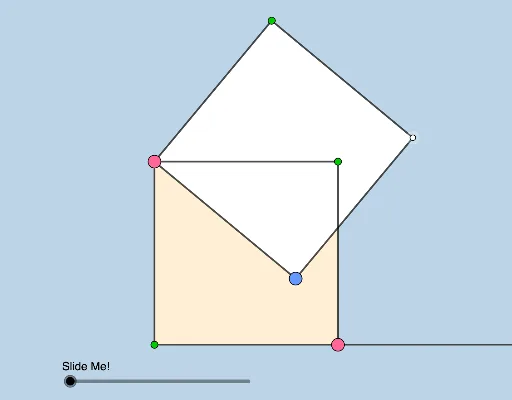
Dynamic Illustration of Two Squares with a Common Vertex
Loading the math board and drawing, please wait…
This example dynamically illustrates a problem posted by Catriona Shearer on Twitter. It involves two squares that share a common vertex. Using GeoGebra commands such as Polygon, Segment, Circle, Point, etc., the relationship between the squares can be observed intuitively. Suitable for students at the junior high school level and above to learn geometric construction and transformations.
GeoGebra Commands & Parameters
Polygon(A, B, C, D) → q1, a_1, b, c, dSegment(A, B) → fSegment(B, C) → gSegment(C, D) → hSegment(D, A) → iCircle(D, a) → ePoint(e) → ESegment(D, E) → jOrthogonalLine(E, j) → kCircle(E, a) → pIntersect(p, k, 2) → FOrthogonalLine(F, k) → lOrthogonalLine(D, j) → mIntersect(e, l, 1) → GPolygon(D, E, F, G) → q2, d_1, e_1, f_1, g_1Segment(E, F) → nSegment(F, G) → qSegment(G, D) → rLine(G, C) → sLine(G, A) → tAngle(A, G, C) → αLine(B, D) → h_1Circle(B, u) → c_1Intersect(c_1, f, 1) → HDilate(G, If[0 < o ≤ 1, 1 - o, 0], A) → G'Dilate(G, If[0 < o ≤ 1, 1 - o, 0], C) → G'_1Segment(G, G') → i_1Segment(G, G'_1) → j_1Intersect(c_1, xAxis, 2) → IRotate(I, π / 4, B) → I'Ray(B, I') → k_1Circle(I', B) → p_1Intersect(p_1, k_1, 2) → JDilate(B, If[1 < o ≤ 2, 2 - o, 0], J) → B'Segment(B, B') → l_1Rotate(I, If[2.5 < o ≤ 3.5, ((o - 2.5) * π / 4), π / 4], B) → I'_1CircleSector(B, I, I'_1) → q_1Rotate(q_1, If[4.5 < o ≤ 5.5, ((o - 4.5) * π / 4), π / 4], B) → r_1Dilate(B, If[6.5 < o ≤ 7.5, 7.5 - o, 0], G) → B'_1Vector(B, B'_1) → vTranslate(r_1, v) → s_1Line(G, l_1) → m_1Point(m_1) → KAngle(A, G, K) → βRotate(s_1, If[6.5 < o ≤ 7.5, ((-(o - 6.5)) * β), (-β)], B'_1) → t_1Line(G, C) → n_1Ray(A, B) → b_1