
Dynamic Illustration of Triangle Incircle and Midpoints
Loading the math board and drawing, please wait…
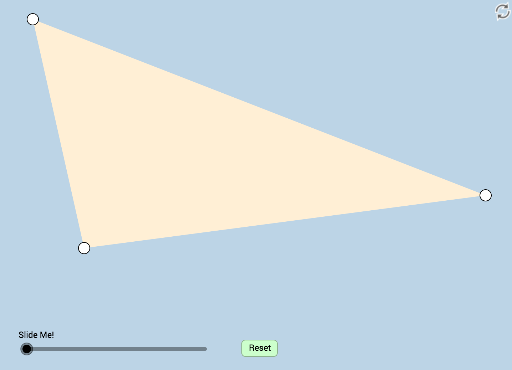
This example dynamically illustrates the geometric relationship among a triangle's incircle and the midpoints of two of its sides. Key math concepts include incircle, similar triangles, and geometric transformations. Construction highlights the use of GeoGebra commands like Midpoint, Segment, Dilate, Rotate, Polygon, Angle, Ray, Intersect, OrthogonalLine, Min, Circle, CircleSector, CircleArc, and Line, along with objects A, B, C, etc. Suitable for high school mathematics education or exploration by geometry enthusiasts.
GeoGebra Commands & Parameters
Midpoint(A, B) → DMidpoint(B, C) → EMidpoint(C, A) → FSegment(A, B) → aSegment(B, C) → bSegment(C, A) → cSegment(C, D) → dSegment(A, E) → eSegment(B, F) → fDilate(A, If[0 < g ≤ 1, 1 - g, 0], D) → A'Segment(A, A') → hRotate(A, If[1 < g ≤ 2, ((-(g - 1)) * π), (-π)], D) → A'_1Rotate(A', If[1 < g ≤ 2, ((g - 1) * π), 3.141592653589793], D) → A''Segment(A'_1, A'') → h'Dilate(B, If[2 < g ≤ 3, 3 - g, 0], E) → B'Segment(B, B') → iRotate(B, If[3 < g ≤ 4, ((-(g - 3)) * π), (-π)], E) → B'_1Rotate(B', If[3 < g ≤ 4, ((g - 3) * π), 3.141592653589793], E) → B''Segment(B'_1, B'') → i'Dilate(C, If[4 < g ≤ 5, 5 - g, 0], F) → C'Segment(C, C') → jRotate(C, If[5 < g ≤ 6, ((-(g - 5)) * π), (-π)], F) → C'_1Rotate(C', If[5 < g ≤ 6, ((g - 5) * π), 3.141592653589793], F) → C''Segment(C'_1, C'') → j'Polygon(A, B, C) → poly1, c_1, a_1, b_1Angle(B, A, C) → αAngle(A, C, B) → βAngle(C, B, A) → γRotate(B, α / 2, A) → B'_2Angle(B, A, B'_2) → δRay(A, B'_2) → kRotate(C, γ / 2, B) → C'_3Angle(C, B, C'_3) → εRay(B, C'_3) → lIntersect(k, l) → OSegment(C, B) → mSegment(C, A) → nIntersect(m, k) → PIntersect(l, n) → QSegment(A, B) → sOrthogonalLine(O, s) → tOrthogonalLine(O, m) → f_1Segment(C, A) → g_1OrthogonalLine(O, g_1) → h_1Intersect(h_1, g_1) → RIntersect(t, s) → SIntersect(f_1, m) → TDilate(O, If[10 < g ≤ 11, 11 - g, 0], S) → O'Segment(O, O') → i_1Min({g_1, s, m}) → oCircle(A, (0.25 * o)) → d_1Circle(B, (0.25 * o)) → e_1Intersect(d_1, g_1) → U,Intersect(d_1, s) → V,Intersect(e_1, m) → W,Intersect(e_1, s) → Z,Intersect(d_1, k) → A_1,Intersect(e_1, l) → B_1,CircleSector(A, V, A_1) → k_1CircleSector(B, W, B_1) → p_1Dilate(A, If[6 < g ≤ 7, 7 - g, 0], O) → A'_3Segment(A, A'_3) → j_1Dilate(B, If[7 < g ≤ 8, 8 - g, 0], O) → B'_3Segment(B, B'_3) → pRotate(k_1, If[8 < g ≤ 9, ((g - 8) * δ), δ], A) → qRotate(p_1, If[9 < g ≤ 10, ((g - 9) * ε), ε], B) → rAngle(O, S, A) → ζRotate(S, If[11 < g ≤ 13, ((g - 11) * π), (2 * π)], O) → S'CircleArc(O, S, S') → q_1Circle(O, S) → r_1Segment(F, E) → l_1Line(C, S) → m_1Intersect(m_1, l_1) → GDilate(C, If[13 < g ≤ 14, 14 - g, 0], S) → C'_2Segment(C, C'_2) → n_1Dilate(E, If[14 < g ≤ 15, 15 - g, 0], G) → E'Segment(E, E') → s_1Dilate(G, If[15 < g ≤ 16, 16 - g, 0], F) → G'Segment(G, G') → t_1Dilate(D, If[16 < g ≤ 17, 17 - g, 0], O) → D'Segment(D, D') → f_2Dilate(O, If[17 < g ≤ 18, 18 - g, 0], G) → O'_1Segment(O, O'_1) → g_2