
Dynamic Illustration of Similar Rectangles
Loading the math board and drawing, please wait…
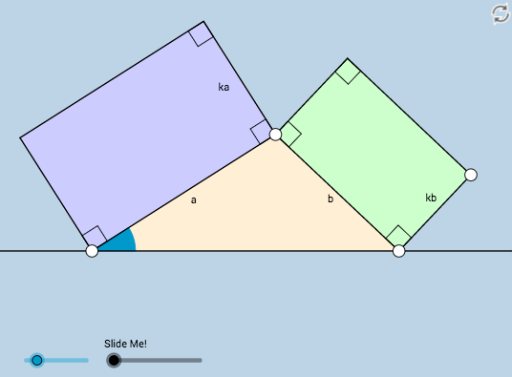
This is a dynamic and modifiable illustration of a theorem involving similar rectangles built off two sides of a triangle. Using GeoGebra commands such as Rotate, Ray, Point, Segment, etc., the properties of similar rectangles can be visually demonstrated. Suitable for middle school and above students to learn about similar figures and triangle-related concepts.
GeoGebra Commands & Parameters
Rotate(A, (a_4 * π / 180), B) → A'Ray(B, A') → gPoint(g) → CSegment(B, C) → aOrthogonalLine(C, a) → sSegment(C, A) → bOrthogonalLine(A, b) → lPoint(l) → DRay(A, D) → mPoint(m) → ELine(B, E) → p_1Segment(A, E) → rCircle(C, (b_3 * a)) → cIntersect(c, s) → G, HLine(H, a) → tOrthogonalLine(B, t) → dIntersect(t, d) → ILine(I, A) → q_1Angle(A, B, A') → αRay(B, A) → fLine(B, A) → iOrthogonalLine(C, b) → kOrthogonalLine(E, m) → nIntersect(k, n) → FSegment(C, F) → pSegment(F, E) → qSegment(H, C) → eSegment(B, I) → f_1Segment(I, H) → g_1OrthogonalLine(C, i) → h_1Intersect(i, h_1) → JAngle(C, J, B) → βSegment(B, E) → i_1Segment(A, I) → j_1Dilate(B, If[0 < u ≤ 1, 1 - u, 0], E) → B'Segment(B, B') → k_1Dilate(A, If[1 < u ≤ 2, 2 - u, 0], I) → A'_1Segment(A, A'_1) → l_1Intersect(p_1, q_1) → KDilate(C, If[2 < u ≤ 3, 3 - u, 0], K) → C'Segment(C, C') → m_1Dilate(K, If[3 < u ≤ 4, 4 - u, 0], J) → K'Segment(K, K') → n_1Line(C, J) → r_1Circle(C, 1) → c_1Intersect(c_1, r_1, 1) → LRay(C, L) → s_1Line(J, C) → t_1Circle(J, 1) → d_1Intersect(d_1, t_1, 1) → MRay(J, M) → a_1Polygon(B, A, C) → poly1, c_2, b_1, a_2Polygon(A, E, F, C) → poly2, a_3, e_1, f_2, c_3Polygon(C, H, I, B) → poly3, c_4, h_2, i_2, b_2Angle(C, B, I) → γAngle(H, C, B) → δAngle(I, H, C) → εAngle(A, C, F) → ζAngle(C, F, E) → ηAngle(E, A, C) → θMin(a, Distance[A, B]) → vCircle(B, (0.2 * a)) → d_2Intersect(d_2, i, 2) → NIntersect(d_2, a, 1) → OCircleSector(B, N, O) → e_2