
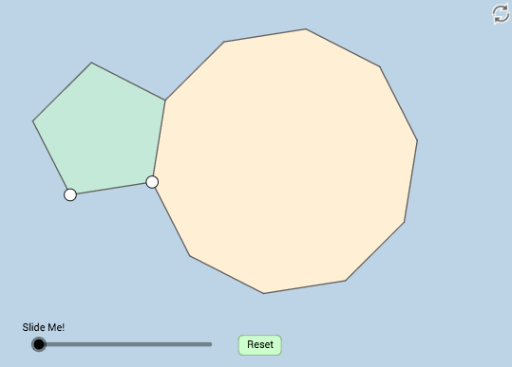
Dynamic Illustration of Relationship Between Regular Pentagon and Decagon
Loading the math board and drawing, please wait…
This example dynamically illustrates the relationship between a regular pentagon and a regular decagon. It involves key mathematical concepts such as angles, polygons, and geometric transformations. Using GeoGebra commands like Polygon, Segment, Intersect, etc., it provides a clear understanding of the transformations and relationships between these geometric shapes. Suitable for middle school and above students or teachers.
GeoGebra Commands & Parameters
Polygon(A, B, 5) → poly1, f, g, h, i, j, C, D, EPolygon(C, B, 10) → poly2, k, a, F, G, H, I, J, K, L, M, l, m, n, p, q, r, s, tSegment(F, G) → bSegment(G, H) → cSegment(H, I) → dSegment(I, J) → eSegment(J, K) → f_1Segment(K, L) → g_1Segment(L, M) → h_1Segment(M, C) → i_1Segment(C, B) → j_1Segment(B, F) → k_1Segment(B, A) → l_1Segment(A, E) → m_1Segment(E, D) → n_1Segment(D, C) → p_1Segment(D, K) → r_1Segment(A, L) → q_1Intersect(r_1, q_1) → NSegment(E, B) → s_1Segment(E, C) → t_1Circle(E, (0.35 * n_1)) → c_1Intersect(c_1, n_1, 1) → OIntersect(c_1, t_1, 1) → PIntersect(c_1, s_1, 1) → QIntersect(c_1, m_1, 1) → RCircleSector(E, R, Q) → d_1Dilate(A, If[0 < o ≤ 1, 1 - o, 0], N) → A'Segment(A, A') → a_1Dilate(N, If[1 < o ≤ 2, 2 - o, 0], L) → N'Segment(N, N') → b_1Dilate(D, If[2 < o ≤ 3, 3 - o, 0], N) → D'Segment(D, D') → e_1Dilate(N, If[3 < o ≤ 4, 4 - o, 0], K) → N'_1Segment(N, N'_1) → f_2Dilate(E, If[4 < o ≤ 5, 5 - o, 0], B) → E'Segment(E, E') → g_2Dilate(E, If[5 < o ≤ 6, 6 - o, 0], C) → E'_1Segment(E, E'_1) → h_2Rotate(d_1, If[7 < o ≤ 8, (((o - 7) * 36) * π / 180), (36 * π / 180)], E) → c_2Rotate(c_2, If[8.5 < o ≤ 9.5, (((o - 8.5) * 36) * π / 180), (36 * π / 180)], E) → d_2Line(N, n_1) → i_2Line(E, a_1) → j_2Dilate(E, If[10 < o ≤ 11, 11 - o, 0], N) → E'_2Vector(E, E'_2) → uTranslate(d_2, u) → e_2Point(i_2) → TAngle(A, N, T) → αRotate(e_2, If[11 < o ≤ 12, ((o - 11) * (π - α)), π - α], N) → k_2