
Dynamic Illustration of Perpendicular Secant Segments in a Circle
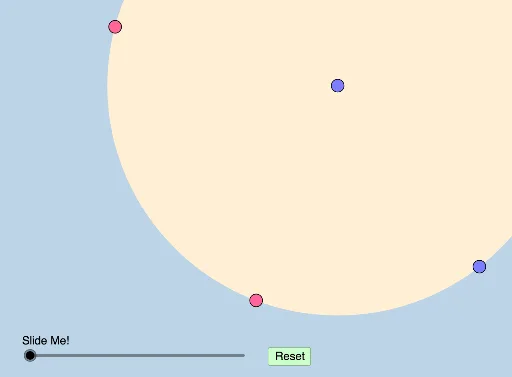
Loading the math board and drawing, please wait…
This example dynamically demonstrates a problem involving perpendicular secant segments within a circle context. It covers core concepts like circles, secants, perpendicularity, and intersecting chords theorem. Construction uses GeoGebra commands such as Circle, Intersect, CircleArc, Point, Segment, Line, OrthogonalLine, Dilate, Angle, Vector, Translate, and Rotate. Suitable for high school mathematics education to understand the relationship between circles and secants and for dynamic geometry demonstrations.
GeoGebra Commands & Parameters
Circle(A_1, B_1) → cIntersect(c, f, 1) → D_1Intersect(c, f, 2) → E_1CircleArc(A_1, D_1, E_1) → c_1Intersect(c, g, 1) → F_1CircleArc(A_1, F_1, E_1) → dPoint(c_1) → DIntersect(c, j) → H_1, ICircleArc(A_1, H_1, F_1) → kCircleArc(A_1, D_1, F_1) → ePoint(k) → CIntersect(c, h, 2) → EIntersect(c, i) → K, BIntersect(h, i) → ASegment(C, A) → lSegment(A, E) → mLine(E, B) → nOrthogonalLine(C, n) → pIntersect(n, p) → GLine(C, D) → qOrthogonalLine(A, q) → rIntersect(q, r) → HOrthogonalLine(D, n) → sIntersect(n, s) → FSegment(A, H) → tCircle(G, t) → d_1Intersect(d_1, n, 1) → JDilate(D, If[0 < b ≤ 1, 1 - b, 0], A) → D'Dilate(C, If[0 < b ≤ 1, 1 - b, 0], A) → C'Segment(D, D') → f_1Segment(C, C') → g_1Angle(D, A, C) → αDilate(D, If[2 < b ≤ 3, 3 - b, 0], E) → D'_1Segment(D, D'_1) → h_1Dilate(E, If[3 < b ≤ 4, 4 - b, 0], F) → E'Segment(E, E') → i_1Dilate(D, If[3 < b ≤ 4, 4 - b, 0], F) → D'_2Segment(D, D'_2) → j_1Dilate(F, If[4 < b ≤ 5, 5 - b, 0], J) → F'Segment(F, F') → k_1Dilate(J, If[5 < b ≤ 6, 6 - b, 0], G) → J'Segment(J, J') → l_1Dilate(C, If[5 < b ≤ 6, 6 - b, 0], G) → C'_1Segment(C, C'_1) → m_1Dilate(C, If[7 < b ≤ 8, 8 - b, 0], D) → C'_2Segment(C, C'_2) → n_1Dilate(A, If[8 < b ≤ 9, 9 - b, 0], H) → A'Segment(A, A') → p_1Dilate(A, If[10 < b ≤ 11, 11 - b, 0], G) → A'_1Vector(A, A'_1) → uTranslate(A, u) → A'_2Translate(A', u) → A''Segment(A'_2, A'') → q_1Line(A, l_1) → r_1Point(r_1) → NAngle(N, A, H) → βRotate(A'_2, If[10 < b ≤ 11, ((-(b - 10)) * β), (-β)], A'_2) → ORotate(A'', If[10 < b ≤ 11, ((-(b - 10)) * β), (-β)], A'_2) → A'''Segment(O, A''') → s_1Dilate(A, If[11 < b ≤ 12, 12 - b, 0], J) → A'_3Vector(A, A'_3) → vTranslate(A, v) → A'_4Translate(A', v) → A''_1Segment(A'_4, A''_1) → t_1Rotate(A'_4, If[11 < b ≤ 12, ((-(b - 11)) * β), (-β)], A'_4) → PRotate(A''_1, If[11 < b ≤ 12, ((-(b - 11)) * β), (-β)], A'_4) → QSegment(P, Q) → a_1Angle(E, G, C) → γAngle(D, F, E) → δAngle(C, H, A) → εSegment(G, B) → b_1
AI Drawing Prompt Reference
Draw a circle and two secant lines from an external point intersecting the circle. Mark the intersection points of the secants with the circle. Then, draw arcs between the intersection points and the external point, and find the midpoints of these arcs. Next, draw the perpendicular bisectors of the secant segments and mark their intersection point. Finally, draw line segments from the center of the circle to the intersection points, and find the points where these segments intersect the perpendicular bisectors to demonstrate the perpendicularity of the secant segments.
The prompt above was compiled from the original drawing commands and is for reference only.