
Dynamic Illustration of External/Internal Tangents Theorem
Loading the math board and drawing, please wait…
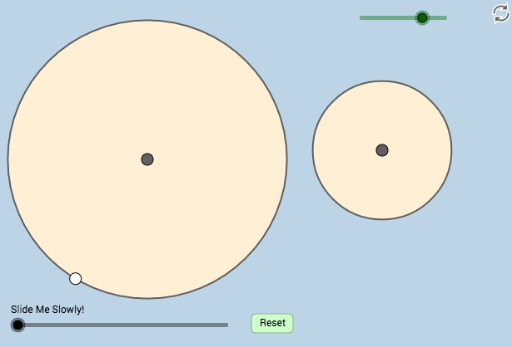
This example dynamically illustrates a less-known theorem regarding segments formed by external and internal tangents of two circles, serving as a follow-up to previous explorations. It involves core mathematical concepts such as circles, tangent lines, similarity transformations, vector operations, and more. The construction utilizes commands like Circle, Segment, PointIn, Distance, Tangent, Intersect, Dilate, Angle, Midpoint, Rotate, Vector, Translate, Line, and Point in GeoGebra. Suitable for high school and above students to explore geometric transformations and theorem validation.
GeoGebra Commands & Parameters
Circle(A, B) → cSegment(A, B) → fPointIn(a) → CDistance(C, c) → bCircle(C, d) → eTangent(c, e) → g, h, i, jIntersect(c, h) → DIntersect(c, j) → E, NIntersect(e, j) → FIntersect(e, h) → G, LIntersect(e, g) → H, KIntersect(e, i) → IIntersect(c, i) → J, MIntersect(c, g) → OCircle(D, 2) → pCircle(E, 2) → qCircle(O, 2) → rCircle(K, 2) → sCircle(I, 2) → tCircle(F, 2) → c_1Circle(G, 2) → d_1Circle(J, 2) → e_1Intersect(e_1, i, 1) → PIntersect(e_1, i, 2) → QIntersect(p, h, 1) → RIntersect(p, h, 2) → SIntersect(c_1, j, 2) → TIntersect(c_1, j, 1) → UIntersect(d_1, h, 1) → VIntersect(d_1, h, 2) → WIntersect(s, g, 2) → ZIntersect(s, g, 1) → A_1Intersect(r, g, 2) → B_1Intersect(r, g, 1) → C_1Intersect(q, j, 2) → D_1Intersect(q, j, 1) → E_1Dilate(A, If[0 < k ≤ 1, 1 - k, 0], D) → A'Dilate(A, If[4 < k ≤ 5, 5 - k, 0], M) → A'_1Dilate(A, If[9 < k ≤ 10, 10 - k, 0], E) → A'_2Dilate(A, If[0 < k ≤ 1, 1 - k, 0], O) → A'_3Angle(A, O, C_1) → αAngle(A, E, E_1) → βAngle(A, J, Q) → γAngle(A, D, S) → δAngle(C, K, A_1) → εIntersect(t, i, 1) → F_1Angle(C, I, F_1) → ζAngle(C, F, T) → ηAngle(C, G, W) → θDilate(C, If[0 < k ≤ 1, 1 - k, 0], G) → C'Dilate(C, If[9 < k ≤ 10, 10 - k, 0], F) → C'_1Dilate(C, If[4 < k ≤ 5, 5 - k, 0], I) → C'_2Dilate(C, If[0 < k ≤ 1, 1 - k, 0], K) → C'_3Segment(A, A') → lSegment(A, A'_1) → mSegment(A, A'_2) → nSegment(A, A'_3) → f_1Segment(C, C') → g_1Segment(C, C'_1) → h_1Segment(C, C'_2) → i_1Segment(C, C'_3) → j_1Intersect(i, j) → G_1Intersect(i, j) → H_1Intersect(h, i) → I_1Intersect(g, j) → J_1Intersect(g, i) → K_1Intersect(h, j) → L_1Segment(I_1, M) → k_1Segment(M, I) → l_1Segment(I, K_1) → m_1Segment(J_1, E) → n_1Segment(E, F) → p_1Segment(F, L_1) → q_1Dilate(K_1, If[1 < k ≤ 2, 2 - k, 0], M) → M_1Dilate(M, If[2 < k ≤ 3, 3 - k, 0], I) → M'Dilate(I, If[3 < k ≤ 4, 4 - k, 0], I_1) → I'Segment(K_1, M_1) → r_1Segment(M, M') → s_1Segment(I, I') → t_1Midpoint(M, I) → N_1Rotate(K_1, If[5 < k ≤ 6, ((k - 5) * π), π], N_1) → O_1Rotate(M_1, If[5 < k ≤ 6, ((k - 5) * π), π], N_1) → P_1Segment(O_1, P_1) → a_1Dilate(J_1, If[6 < k ≤ 7, 7 - k, 0], F) → Q_1Dilate(F, If[7 < k ≤ 8, 8 - k, 0], E) → F'Dilate(E, If[8 < k ≤ 9, 9 - k, 0], L_1) → E'Segment(J_1, Q_1) → b_1Segment(F, F') → f_2Segment(E, E') → g_2Midpoint(Q_1, E) → R_1Rotate(J_1, If[10 < k ≤ 11, ((k - 10) * π), π], R_1) → S_1Rotate(Q_1, If[10 < k ≤ 11, ((k - 10) * π), π], R_1) → T_1Segment(S_1, T_1) → h_2Dilate(L_1, If[11 < k ≤ 12, 12 - k, 0], I_1) → U_1Vector(L_1, U_1) → uTranslate(S_1, u) → V_1Translate(T_1, u) → W_1Segment(V_1, W_1) → i_2Line(I_1, f_2) → j_2Point(j_2) → Z_1Angle(Z_1, I_1, M') → ιRotate(V_1, If[12 < k ≤ 13, ((k - 12) * ι), ι], I_1) → A_2Rotate(W_1, If[12 < k ≤ 13, ((k - 12) * ι), ι], I_1) → B_2Segment(A_2, B_2) → k_2Midpoint(E, M_1) → C_2Rotate(S_1, If[13 < k ≤ 14, ((-(k - 13)) * π), (-π)], C_2) → D_2Rotate(T_1, If[13 < k ≤ 14, ((-(k - 13)) * π), (-π)], C_2) → E_2Segment(D_2, E_2) → l_2Line(M_1, f_2) → m_2Point(m_2) → F_2Angle(K_1, M_1, F_2) → κRotate(D_2, If[14 < k ≤ 15, ((-(k - 14)) * κ), (-κ)], M_1) → G_2Rotate(E_2, If[14 < k ≤ 15, ((-(k - 14)) * κ), (-κ)], M_1) → H_2Segment(G_2, H_2) → n_2
AI Drawing Prompt Reference
Draw two intersecting circles and find their common tangents and internal tangents. Create small circles at the intersection points of these tangents, and use these circles and points to construct a series of new shapes involving rotations, dilations, and translations. Measure and display key angles to illustrate similarity and vector relationships, resulting in a dynamic illustration of a geometric theorem validation.
The prompt above was compiled from the original drawing commands and is for reference only.