
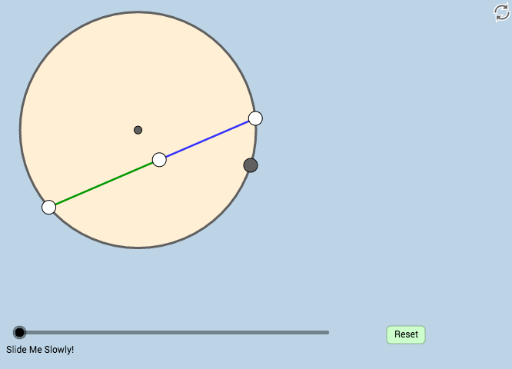
Dynamic Illustration of a Special Theorem on Concurrent Chords in a Circle
Loading the math board and drawing, please wait…
In collections
Circles (Theorems)
This example dynamically illustrates a special theorem concerning a set of three concurrent chords in a circle. Key mathematical concepts include circles, angles, and geometric construction. Using GeoGebra commands such as Circle, Point, Rotate, Intersect, etc., the properties of these chords can be observed. Suitable for high school mathematics education and learning.
GeoGebra Commands & Parameters
Circle(A, B) → cRadius(c) → oPoint(c) → DPoint(c) → CSegment(C, D) → fPoint(f) → ERotate(C, π / 3, E) → C'Line(E, C') → gIntersect(c, g, 2) → FLine(F, g_1) → l_1Point(l_1) → G_1Angle(C, E, C') → αRotate(C', π / 3, E) → C''Angle(C', E, C'') → βLine(E, C'') → hSegment(C, E) → iSegment(E, D) → jIntersect(c, g, 1) → GSegment(E, F) → kSegment(E, G) → lIntersect(c, h, 1) → HIntersect(c, h, 2) → ISegment(E, H) → mSegment(E, I) → nMin(list) → aCircle(E, (0.28 * a)) → dIntersect(d, k, 1) → JIntersect(f, i) → KIntersect(f, i) → LIntersect(f, i) → MIntersect(f, i) → NIntersect(d, i) → O,Intersect(d, m) → P, H_1CircleSector(E, P, O) → eSegment(D, E) → pSegment(E, C) → qDilate(I, If[0 < b ≤ 1, 1 - b, 0], E) → I'Segment(I, I') → rIntersect(c, r, 1) → RDilate(E, If[1 < b ≤ 2, 2 - b, 0], H) → E'Segment(E, E') → sDilate(F, If[2 < b ≤ 3, 3 - b, 0], E) → F'Segment(F, F') → tDilate(E, If[3 < b ≤ 4, 4 - b, 0], G) → E'_1Segment(E, E'_1) → f_1Rotate(e, If[5 < b ≤ 6, ((b - 5) * π / 3), π / 3], E) → e'Rotate(e', If[7 < b ≤ 8, ((b - 7) * π / 3), π / 3], E) → e''Circle(Q, p) → c_1Intersect(c_1, g_1, 2) → TCircle(T, t) → d_1Intersect(d_1, g_1, 2) → UCircle(U, s) → e_1Intersect(e_1, g_1, 2) → VCircle(S, r) → k_1Line(E, g_1) → i_1Line(D, g_1) → j_1Dilate(S, If[9 < b ≤ 10, 10 - b, 0], Q) → S'Segment(S, S') → m_1Dilate(Q, If[10 < b ≤ 11, 11 - b, 0], V) → Q'Vector(Q, Q') → wTranslate(S, w) → S'_1Translate(S', w) → S''Segment(S'_1, S'') → n_1Point(j_1) → B_1Point(j_1) → C_1Angle(B_1, D, E) → γDilate(D, If[11 < b ≤ 12, 12 - b, 0], Q) → D'Vector(D, D') → u_1Translate(D, u_1) → D'_1Translate(E, u_1) → E'_2Segment(D'_1, E'_2) → p'Rotate(D'_1, If[11 < b ≤ 12, ((-(b - 11)) * γ), (-γ)], D'_1) → D_1Rotate(E'_2, If[11 < b ≤ 12, ((-(b - 11)) * γ), (-γ)], D'_1) → E_1Segment(D_1, E_1) → p''Dilate(F, If[12 < b ≤ 13, 13 - b, 0], T) → F'_1Vector(F, F'_1) → v_1Translate(F, v_1) → F'_2Translate(F', v_1) → F''Angle(E, F, G_1) → δSegment(F'_2, F'') → t'Rotate(F'_2, If[12 < b ≤ 13, ((b - 12) * δ), δ], F'_1) → F_1Rotate(F'', If[12 < b ≤ 13, ((b - 12) * δ), δ], F'_1) → F'''Segment(F_1, F''') → t''Line(H, j_1) → r_1Point(r_1) → I_1Dilate(H, If[13 < b ≤ 14, 14 - b, 0], U) → H'Angle(I_1, H, E) → εVector(H, H') → w_1Translate(E, w_1) → E'_3Translate(E', w_1) → E''Segment(E'_3, E'') → s'Rotate(E'_3, If[13 < b ≤ 14, ((-(b - 13)) * ε), (-ε)], E'') → J_1Rotate(E'', If[13 < b ≤ 14, ((-(b - 13)) * ε), (-ε)], E'') → E'''Segment(J_1, E''') → s''Dilate(G, If[14 < b ≤ 15, 15 - b, 0], S) → G'Vector(G, G') → a_1Translate(E, a_1) → E'_4Translate(E'_1, a_1) → K_1Segment(E'_4, K_1) → s_1Line(G, j_1) → t_1Point(t_1) → L_1Angle(L_1, G, E) → ζRotate(E'_4, If[14 < b ≤ 15, ((-(b - 14)) * ζ), (-ζ)], K_1) → M_1Rotate(K_1, If[14 < b ≤ 15, ((-(b - 14)) * ζ), (-ζ)], K_1) → N_1Segment(M_1, N_1) → b_1Circle(S, b_1) → c_2Intersect(c_2, h_1, 2) → O_1Circle(O_1, r) → p_1Intersect(p_1, h_1, 2) → WDilate(R, If[15 < b ≤ 16, 16 - b, 0], O_1) → R'Vector(I, R') → q_1Translate(I, q_1) → I'_1Translate(I', q_1) → I''Segment(I'_1, I'') → r'Line(I, i_1) → f_2Point(f_2) → ZAngle(E, I, Z) → ηRotate(I'_1, If[15 < b ≤ 16, ((b - 15) * η), η], I'_1) → A_1Rotate(I'', If[15 < b ≤ 16, ((b - 15) * η), η], I'_1) → I'''Segment(A_1, I''') → r''Dilate(E, If[16 < b ≤ 17, 17 - b, 0], W) → E'_5Vector(E, E'_5) → u_2Translate(E, u_2) → E'_6Translate(C, u_2) → C'_1Segment(E'_6, C'_1) → q'Point(i_1) → P_1Angle(P_1, E, C) → θRotate(E'_6, If[16 < b ≤ 17, ((-(b - 16)) * θ), (-θ)], E'_6) → Q_1Rotate(C'_1, If[16 < b ≤ 17, ((-(b - 16)) * θ), (-θ)], E'_6) → R_1Segment(Q_1, R_1) → q''Dilate(G, If[17 < b ≤ 18, 18 - b, 0], E) → G'_1Dilate(D, If[17 < b ≤ 18, 18 - b, 0], E) → D'_2Dilate(R, If[17 < b ≤ 18, 18 - b, 0], E) → R'_1Dilate(F, If[17 < b ≤ 18, 18 - b, 0], E) → F'_3Dilate(C, If[17 < b ≤ 18, 18 - b, 0], E) → C'_2Dilate(H, If[17 < b ≤ 18, 18 - b, 0], E) → H'_1Segment(D, D'_2) → g_2Segment(I, R'_1) → h_2Segment(F, F'_3) → i_2Segment(C, C'_2) → j_2Segment(H, H'_1) → k_2Segment(G, G'_1) → l_2