
Dynamic Geometry Problem Example: Circle and Line Segment
Loading the math board and drawing, please wait…
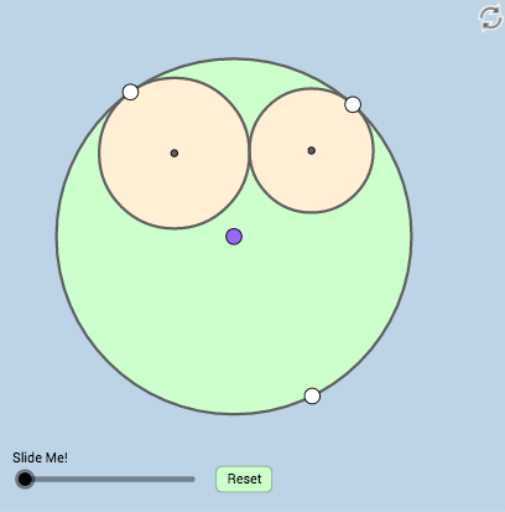
This is a dynamic and modifiable geometry problem example posted by Antonino Gutierrez on Twitter. The example demonstrates the relationship between a circle and a line segment. Key mathematical concepts include circles, line segments, and geometric construction. Using GeoGebra commands such as Point, Circle, Segment, Intersect, etc., one can dynamically explore the changes in geometric shapes. Suitable for high school geometry learners and educators.
GeoGebra Commands & Parameters
Point(yAxis) → BCircle(A, B) → cSegment(A, B) → fPoint(c) → CLine(C, A) → gIntersect(c, g, 2) → DSemicircle(D, C) → dPoint(d) → ECircleArc(A, C, E) → ePoint(e) → FSegment(F, D) → hSegment(E, C) → iIntersect(h, i) → GTangent(F, c) → j,Tangent(E, c) → k,LineBisector(E, G) → lLine(E, A) → mIntersect(m, l) → HCircle(H, E) → pLine(F, A) → nLineBisector(G, F) → qIntersect(n, q) → ICircle(I, F) → rDilate(F, If[0 < a ≤ 1, 1 - a, 0], G) → F'Segment(F, F') → sDilate(G, If[1 < a ≤ 2, 2 - a, 0], D) → G'Segment(G, G') → tDilate(E, If[2 < a ≤ 3, 3 - a, 0], G) → E'Segment(E, E') → bDilate(G, If[3 < a ≤ 4, 4 - a, 0], C) → G'_1Segment(G, G'_1) → f_1Dilate(D, If[6 < a ≤ 7, 7 - a, 0], A) → D'Segment(D, D') → g_1Dilate(A, If[7 < a ≤ 8, 8 - a, 0], C) → A'Segment(A, A') → h_1
AI Drawing Prompt Reference
Draw a circle and a line segment connecting two points on the circle. Start by taking point B on the y-axis and drawing circle c with A and B as center and radius. Then, draw line segment f connecting A and B. On circle c, take point C, draw line g through A, and find intersection D of g and c. Draw semicircle d with D as center and C as radius. Take point E on d, draw circular arc e with A and C as centers and E as endpoint, and take point F on e. Draw line segment h from F to D, and line segment i from E to C, and find their intersection G. Draw tangents j and k from F and E to circle c, and draw the perpendicular bisector l of F and E, and the perpendicular bisector m of E and A, and find their intersection H. Draw circle p with H as center and E as radius. Draw line segment n from F to A, and draw the perpendicular bisector q of F and E, and find their intersection I. Draw circle r with I as center and F as radius. Adjust the positions of F, G, E, G', E', G'_1, D', and A' based on parameter a, and finally draw line segments F and F', G and G', E and E', G and G'_1, D and D', and A and A'.
The prompt above was compiled from the original drawing commands and is for reference only.