
Dynamic Geometry: Antonio Gutierrez's Theorem
Loading the math board and drawing, please wait…
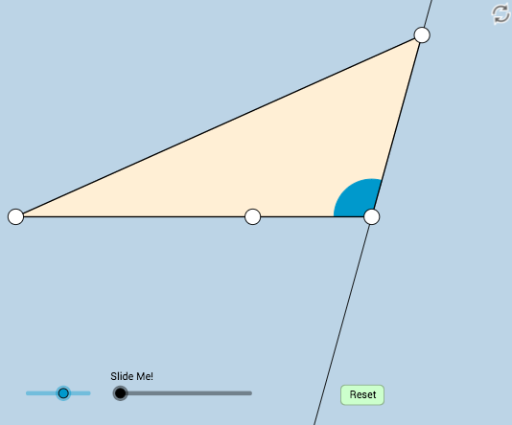
This example dynamically illustrates a theorem by Antonio Gutierrez, showcasing its applicability through adjustable parameters. Core math concepts include variance, planes, quadratic equations, indefinite integrals, and expected value. Construction highlights the use of commands like Rotate, Segment, LineBisector, and Dilate, along with objects such as Points and Lines, to build intricate geometric figures. Suitable for high school and above, helping learners grasp complex geometric theorems visually and understand parameter effects.
GeoGebra Commands & Parameters
Rotate(A, (-((a * π / 180))), B) → A'Angle(A', B, A) → αSegment(A, B) → fRay(B, A') → gPoint(g) → CSegment(A, C) → hSegment(B, C) → iLineBisector(i) → jLineBisector(f) → kLine(A, B) → mOrthogonalLine(C, m) → nIntersect(m, n) → EAngle(E, C, A) → γAngle(E, A, C) → εDilate(C, If[3 < o ≤ 4, 4 - o, 0], E) → C'_1Dilate(B, If[3 < o ≤ 4, 4 - o, 0], E) → B'Midpoint(A, B) → JSegment(A, E) → g_1Segment(A, J) → h_1Min(f, i) → uCircle(B, (0.2 * u)) → r_1Intersect(r_1, f) → K,Intersect(r_1, i) → L,CircleSector(B, L, K) → s_1Point(f) → MSegment(C, M) → pLine(C, M) → qOrthogonalLine(A, q) → rIntersect(q, r) → NLine(C, B) → sOrthogonalLine(A, s) → cIntersect(s, c) → OLine(N, O) → eOrthogonalLine(C, e) → i_1Intersect(e, i_1) → PAngle(A, C, M) → θAngle(O, C, P) → ιSegment(C, P) → j_1Min({h, p, i, j_1}) → vCircle(C, (0.4 * v)) → c_1Intersect(c_1, h) → Q,Intersect(c_1, p) → R,CircleSector(C, Q, R) → d_1Dilate(C, If[0 < o ≤ 1, 1 - o, 0], M) → C'_2Segment(C, C'_2) → tAngle(M, N, A) → κ_1Dilate(M, If[1 < o ≤ 2, 2 - o, 0], N) → M'Dilate(A, If[1 < o ≤ 2, 2 - o, 0], N) → A'_1Segment(M, M') → f_1Segment(A, A'_1) → k_1Dilate(A, If[2 < o ≤ 3, 3 - o, 0], O) → A'_2Segment(A, A'_2) → l_1Dilate(N, If[3 < o ≤ 4, 4 - o, 0], O) → N'Segment(N, N') → m_1Dilate(O, If[4 < o ≤ 5, 5 - o, 0], P) → O'Dilate(C, If[4 < o ≤ 5, 5 - o, 0], P) → C'_3Angle(C, P, O) → ζSegment(O, O') → n_1Segment(C, C'_3) → p_1Rotate(Q, If[5 < o ≤ 6, ((o - 5) * θ), θ], C) → Q'CircleSector(C, Q, Q') → e_1Angle(A, C, B) → κPolygon(A, B, C) → poly1, c_2, a_1, bRotate(d_1, If[6.5 < o ≤ 7.5, ((o - 6.5) * κ), κ], C) → q_1Circle(B, 1) → dCircle(C, 1) → t_1Intersect(d, s) → D, FIntersect(t_1, s) → G, HRay(B, F) → lRay(C, G) → b_1Angle(C, O, A) → β
AI Drawing Prompt Reference
Draw a dynamic geometric illustration of Antonio Gutierrez's theorem with adjustable parameters. Include points and line segments that are rotated and scaled to generate multiple auxiliary points and lines. Construct angle bisectors of two line segments and find their intersection point. Draw perpendicular lines and circles centered at the intersection point relative to the line segments. Use these geometric objects to build intricate figures, showing how parameter changes affect the shape.
The prompt above was compiled from the original drawing commands and is for reference only.