
Dynamic Exploration of Equal Areas in a Regular Hexagon
Loading the math board and drawing, please wait…
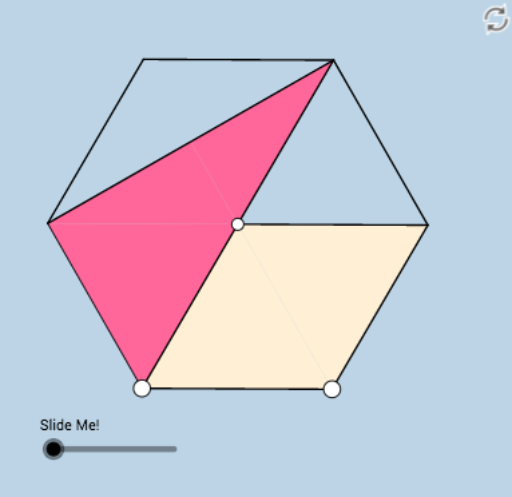
① This interactive GeoGebra applet dynamically demonstrates that certain regions inside a regular hexagon have equal areas, with modifiable points allowing real-time exploration. ② Core mathematical concepts include properties of regular polygons, area partitioning, equal-area transformations, symmetry via rotation and dilation, and implicit connections to the Pythagorean theorem and rational numbers. ③ Construction uses GeoGebra commands such as Point, Polygon, Segment, Midpoint, Dilate, Rotate, and Intersect, creating multiple polygons (poly1, poly2, poly3, poly4) and auxiliary points (A, B, C, D, E, F, G, G', etc.) to generate symmetric equal-area regions through rotation and scaling, with intersection points defining boundaries. ④ Suitable for middle and high school geometry classes, math labs, or self-study, this applet helps students visualize area conservation and explore geometric constructions dynamically, making it a valuable teaching tool for demonstrating equal-area proofs in regular hexagons.
GeoGebra Commands & Parameters
Point(xAxis) → BPolygon(A, B, 6) → poly1, f, F, g, h, i, j, k, C, D, ESegment(F, D) → lSegment(A, D) → mMidpoint(m) → GSegment(G, C) → nPolygon(A, G, B) → poly3, b, a_1, g_1Polygon(G, C, B) → poly4, b_1, g_2, cSegment(F, E) → pSegment(E, D) → qSegment(D, C) → rSegment(C, B) → sSegment(B, A) → tSegment(A, F) → ePolygon(A, G, F) → poly2, f_1, a, g_3Dilate(G, If[0 < o ≤ 1, 1 - o, 0], B) → G'Segment(G, G') → h_1Rotate(A, If[1 < o ≤ 2, ((-(o - 1)) * π / 3), ((-π)) / 3], G) → A'Rotate(G, If[1 < o ≤ 2, ((-(o - 1)) * π / 3), ((-π)) / 3], G) → G'_1Rotate(B, If[1 < o ≤ 2, ((-(o - 1)) * π / 3), ((-π)) / 3], G) → B'Polygon(A', G'_1, B') → poly3', b', a', g'_1Rotate(G, If[2 < o ≤ 3, ((2 * (o - 2)) * π / 3), (2 * π / 3)], G) → G'_2Rotate(C, If[2 < o ≤ 3, ((2 * (o - 2)) * π / 3), (2 * π / 3)], G) → C'Rotate(B, If[2 < o ≤ 3, ((2 * (o - 2)) * π / 3), (2 * π / 3)], G) → B'_1Polygon(G'_2, C', B'_1) → poly4', b'_1, g'_2, c'Midpoint(l) → HDilate(E, If[3 < o ≤ 4, 4 - o, 0], F) → E'Segment(I, E') → j_1Intersect(j_1, l) → JPolygon(G, D, E') → poly6, e', g_4, d_1Polygon(F, G, H) → poly8, h_3, f_3, g_5Polygon(G, H, D) → poly5, d, g_6, h_2Segment(G, A) → i_1Intersect(l, r) → KSegment(G, K) → k_1