
Dynamic Equal Area Demonstration in Regular Hexagon
Loading the math board and drawing, please wait…
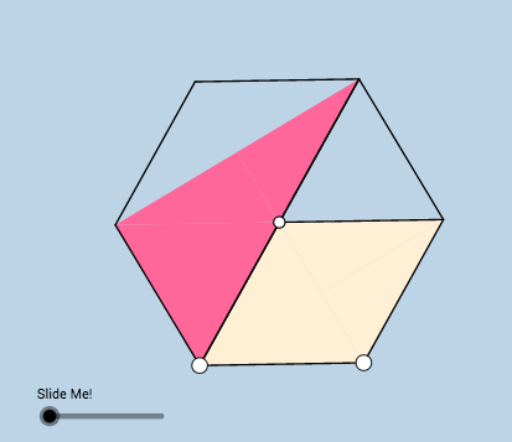
This example dynamically illustrates equal area divisions within a regular hexagon. It involves core math concepts like parametric curves, real numbers, geometric transformations, and integral calculus. Construction uses commands such as Point, Polygon, Segment, Midpoint, Dilate, OrthogonalLine, Rotate, and Intersect. Suitable for high school and above mathematics education to understand geometric transformations and integral applications.
GeoGebra Commands & Parameters
Point(xAxis) → BPolygon(A, B, 6) → poly1, f, F, g, h, i, j, k, C, D, ESegment(A, D) → mMidpoint(m) → GSegment(G, B) → q_1Dilate(G, If[0 < o ≤ 1, 1 - o, 0], B) → G'Segment(G, G') → h_1OrthogonalLine(C, h_1) → p_1Segment(F, D) → lSegment(G, C) → nPolygon(A, G, B) → poly3, b, a_1, g_1Polygon(G, C, B) → poly4, b_1, g_2, cSegment(F, E) → pSegment(E, D) → qSegment(D, C) → rSegment(C, B) → sSegment(B, A) → tSegment(A, F) → ePolygon(A, G, F) → poly2, f_1, a, g_3Rotate(A, If[1 < o ≤ 2, ((-(o - 1)) * π / 3), ((-π)) / 3], G) → A'Rotate(G, If[1 < o ≤ 2, ((-(o - 1)) * π / 3), ((-π)) / 3], G) → G'_1Rotate(B, If[1 < o ≤ 2, ((-(o - 1)) * π / 3), ((-π)) / 3], G) → B'Polygon(A', G'_1, B') → poly3', b', a', g'_1Rotate(G, If[2 < o ≤ 3, ((2 * (o - 2)) * π / 3), (2 * π / 3)], G) → G'_2Rotate(C, If[2 < o ≤ 3, ((2 * (o - 2)) * π / 3), (2 * π / 3)], G) → C'Rotate(B, If[2 < o ≤ 3, ((2 * (o - 2)) * π / 3), (2 * π / 3)], G) → B'_1Midpoint(l) → HDilate(E, If[3 < o ≤ 4, 4 - o, 0], F) → E'Segment(I, E') → j_1Intersect(j_1, l) → JPolygon(F, G, H) → poly8, h_3, f_3, g_5Polygon(G, H, D) → poly5, d, g_6, h_2Segment(G, A) → i_1Intersect(l, r) → KSegment(G, K) → k_1Segment(G, E) → l_1Intersect(l_1, l) → MDilate(D, If[3 < o ≤ 4, 4 - o, 0], F) → D'Segment(D, D') → n_1Intersect(p_1, q_1) → NPolygon(N, G, C) → poly6, c_1, n_2, g_4Polygon(N, C, B) → poly9, b_2, n_3, c_2Rotate(N, If[2 < o ≤ 3, ((2 * (o - 2)) * π / 3), (2 * π / 3)], G) → N'Rotate(G, If[2 < o ≤ 3, ((2 * (o - 2)) * π / 3), (2 * π / 3)], G) → G'_3Rotate(C, If[2 < o ≤ 3, ((2 * (o - 2)) * π / 3), (2 * π / 3)], G) → C'_1Polygon(N', G'_3, C'_1) → poly6', c'_1, n', g'_3Rotate(N, If[2 < o ≤ 3, ((2 * (o - 2)) * π / 3), (2 * π / 3)], G) → N'_1Rotate(C, If[2 < o ≤ 3, ((2 * (o - 2)) * π / 3), (2 * π / 3)], G) → C'_2Rotate(B, If[2 < o ≤ 3, ((2 * (o - 2)) * π / 3), (2 * π / 3)], G) → B'_2Polygon(N'_1, C'_2, B'_2) → poly9', b'_2, n'_1, c'_2Polygon(G, D, M) → poly7, m_1, g_7, d_1Polygon(D, M, E) → poly10, e_1, d_2, m_2Rotate(D, If[4 < o ≤ 5, ((o - 4) * π), π], M) → D'_1Rotate(M, If[4 < o ≤ 5, ((o - 4) * π), π], M) → M'Rotate(E, If[4 < o ≤ 5, ((o - 4) * π), π], M) → E'_1Polygon(D'_1, M', E'_1) → poly10', e'_1, d'_1, m'
AI Drawing Prompt Reference
Construct a regular hexagon and dynamically demonstrate equal-area divisions within it. Start by drawing a segment from one vertex to the midpoint of the opposite side, then take its midpoint as a rotation center. Use a slider parameter to control rotations and dilations, dividing the hexagon into several triangular regions that maintain equal areas as the parameter changes. Include auxiliary segments and intersection points to illustrate the area relationships. The figure shows a symmetric geometric construction suitable for educational demonstrations.
The prompt above was compiled from the original drawing commands and is for reference only.