
Dynamic Demonstration of Rhombus Rotation Phenomenon
Loading the math board and drawing, please wait…
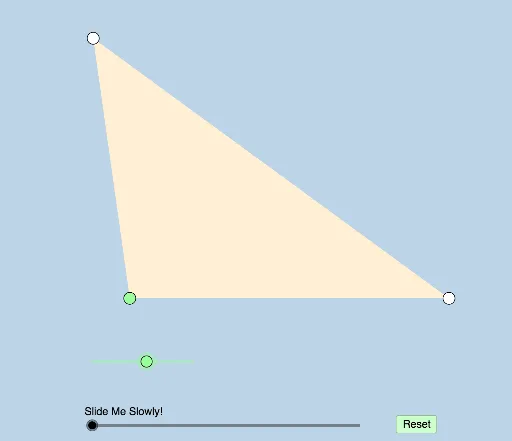
This is a dynamic demonstration of a geometry challenge proof problem, showcasing an interesting phenomenon of a rhombus during rotation. Key mathematical concepts include the properties of a rhombus and rotation transformations. It is constructed using GeoGebra commands such as Segment, Rotate, Angle, Polygon, etc. Suitable for middle school and above students to learn about geometric transformations and proofs.
GeoGebra Commands & Parameters
Segment(A, B) → fRotate(B, (a * π / 180), A) → B'Angle(B, A, B') → αRay(A, B') → gPoint(g) → CPolygon(A, B, C) → t1, c, a_1, bSegment(A, C) → hSegment(C, B) → iCircle(A, f / 3) → dIntersect(d, f, 1) → DMidpoint(D, B) → ECircle(A, h / 3) → eIntersect(e, h, 1) → FMidpoint(F, C) → GCircle(C, i / 3) → kIntersect(k, i, 1) → HMidpoint(H, B) → ISegment(A, H) → jSegment(A, I) → lSegment(C, D) → mSegment(C, E) → nSegment(B, F) → pSegment(B, G) → qIntersect(j, q) → JIntersect(m, p) → KIntersect(l, n) → LPolygon(K, L, J) → t2, j_1, k_1, l_1Vector(K, A) → uTranslate(K, u) → K'Translate(L, u) → L'Translate(J, u) → J'Polygon(K', L', J') → t2', j', k', l'Vector(K, L') → vTranslate(K, v) → K'_1Translate(L, v) → L'_1Translate(J, v) → J'_1Polygon(K'_1, L'_1, J'_1) → t2'_1, j'_1, k'_1, l'_1Vector(L, E) → wVector(J, C) → rTranslate(K, r) → K'_2Translate(L, r) → L'_2Translate(J, r) → J'_2Polygon(K'_2, L'_2, J'_2) → t2'_2, j'_2, k'_2, l'_2Rotate(K, π, J) → K'_3Rotate(L, π, J) → L'_3Rotate(J, π, J) → J'_3Polygon(K'_3, L'_3, J'_3) → t2'_3, j'_3, k'_3, l'_3Vector(K, J') → tTranslate(K, t) → K'_4Translate(L, t) → L'_4Translate(J, t) → J'_4Polygon(K'_4, L'_4, J'_4) → t2'_4, j'_4, k'_4, l'_4Circle(L'_1, j') → c_1Intersect(c_1, f, 2) → MVector(L, M) → u_1Translate(K, u_1) → K'_5Translate(L, u_1) → L'_5Translate(J, u_1) → J'_5Polygon(K'_5, L'_5, J'_5) → t2'_5, j'_5, k'_5, l'_5Vector(L', L'_1) → v_1Translate(K'_5, v_1) → NTranslate(L'_5, v_1) → OTranslate(J'_5, v_1) → PPolygon(N, O, P) → t3, p_1, n_1, o_1Translate(K, v_1) → K'_6Translate(L, v_1) → L'_6Translate(J, v_1) → J'_6Polygon(K'_6, L'_6, J'_6) → t2'_6, j'_6, k'_6, l'_6Dilate(A, If[0 < o ≤ 1, 1 - o, 0], D) → A'Segment(A, A') → f_1Rotate(A, If[1 < o ≤ 2, ((-(o - 1)) * π), (-π)], D) → A'_1Segment(D, A'_1) → g_1Rotate(D, If[2 < o ≤ 3, ((-(o - 2)) * π), (-π)], E) → D'Segment(E, D') → h_1Dilate(B, If[3 < o ≤ 4, 4 - o, 0], I) → B'_1Segment(B, B'_1) → i_1Rotate(B, If[4 < o ≤ 5, ((-(o - 4)) * π), (-π)], I) → B'_2Segment(I, B'_2) → m_1Rotate(I, If[5 < o ≤ 6, ((-(o - 5)) * π), (-π)], H) → I'Segment(H, I') → q_1Dilate(C, If[6 < o ≤ 7, 7 - o, 0], G) → C'Segment(C, C') → r_1Rotate(C, If[7 < o ≤ 8, ((-(o - 7)) * π), (-π)], G) → C'_1Segment(G, C'_1) → s_1Rotate(G, If[8 < o ≤ 9, ((-(o - 8)) * π), (-π)], F) → G'Segment(F, G') → t_1Dilate(A, If[10 < o ≤ 11, 11 - o, 0], J) → A'_2Segment(A, A'_2) → b_1Dilate(B, If[10 < o ≤ 11, 11 - o, 0], J) → B'_3Segment(B, B'_3) → d_1Dilate(J, If[11 < o ≤ 12, 12 - o, 0], G) → J'_7Dilate(J, If[11 < o ≤ 12, 12 - o, 0], H) → J'_8Segment(J, J'_7) → e_1Segment(J, J'_8) → f_2Dilate(A, If[12 < o ≤ 13, 13 - o, 0], L) → A'_3Dilate(C, If[12 < o ≤ 13, 13 - o, 0], L) → C'_2Segment(C, C'_2) → g_2Segment(A, A'_3) → h_2Dilate(L, If[13 < o ≤ 14, 14 - o, 0], E) → L'_7Dilate(L, If[13 < o ≤ 14, 14 - o, 0], I) → L'_8Segment(L, L'_8) → i_2Segment(L, L'_7) → j_2Dilate(C, If[14 < o ≤ 15, 15 - o, 0], K) → C'_3Dilate(B, If[14 < o ≤ 15, 15 - o, 0], K) → B'_4Segment(C, C'_3) → k_2Segment(B, B'_4) → l_2Dilate(K, If[15 < o ≤ 16, 16 - o, 0], D) → K'_7Dilate(K, If[15 < o ≤ 16, 16 - o, 0], F) → K'_8Segment(K, K'_7) → m_2Segment(K, K'_8) → n_2Dilate(J, If[18 < o ≤ 19, 19 - o, 0], K) → J'_9Segment(J, J'_9) → p_2Dilate(K, If[18 < o ≤ 19, 19 - o, 0], L) → K'_9Segment(K, K'_9) → q_2Dilate(L, If[18 < o ≤ 19, 19 - o, 0], J) → L'_9Segment(L, L'_9) → r_2Dilate(K, If[23 < o ≤ 24, 24 - o, 0], A) → K'_{10}Vector(K, K'_{10}) → w_1Translate(K, w_1) → K'_{11}Translate(L, w_1) → L'_{10}Translate(J, w_1) → J'_{10}Polygon(K'_{11}, L'_{10}, J'_{10}) → t2'_7, j'_{10}, k'_{11}, l'_{10}Translate(J, w_1) → J'_{11}Translate(L, w_1) → L'_{11}Midpoint(A, B) → RMidpoint(A, C) → SMidpoint(C, B) → TDilate(A, If[25 < o ≤ 26, 26 - o, 0], K'_1) → A'_4Dilate(A, If[25 < o ≤ 26, 26 - o, 0], R) → A'_5Dilate(A, If[25 < o ≤ 26, 26 - o, 0], N) → A'_6Vector(A, A'_4) → u_2Vector(A, A'_5) → v_2Vector(A, A'_6) → w_2Translate(K'_{11}, u_2) → QTranslate(L'_{10}, u_2) → UTranslate(J'_{10}, u_2) → VPolygon(Q, U, V) → t4, v_3, q_3, u_3Translate(K'_{11}, w_2) → WTranslate(L'_{10}, w_2) → ZTranslate(J'_{10}, w_2) → A_1Polygon(W, Z, A_1) → t5, a_2, w_3, z_1Translate(K'_{11}, v_2) → B_1Translate(L'_{10}, v_2) → C_1Translate(J'_{10}, v_2) → D_1Polygon(B_1, C_1, D_1) → t6, d_2, b_2, c_2Dilate(K'_1, If[26 < o ≤ 27, 27 - o, 0], K) → E_1Vector(K'_1, E_1) → e_2Translate(Q, e_2) → Q'Translate(U, e_2) → U'Translate(V, e_2) → V'Polygon(Q', U', V') → t4', v', q', u'Translate(B_1, e_2) → F_1Translate(C_1, e_2) → G_1Translate(D_1, e_2) → H_1Polygon(F_1, G_1, H_1) → t6', h_3, f_3, g_3Translate(K'_{11}, Vector[(2 * e_2)]) → I_1Translate(L'_{10}, Vector[(2 * e_2)]) → J_1Translate(J'_{10}, Vector[(2 * e_2)]) → K_1Polygon(I_1, J_1, K_1) → t7, k_3, i_3, j_3Translate(K'_{11}, e_2) → L_1Translate(L'_{10}, e_2) → M_1Translate(J'_{10}, e_2) → N_1Polygon(L_1, M_1, N_1) → t8, n_3, l_3, m_3Translate(K'_{11}, Vector[(3 * e_2)]) → O_1Translate(L'_{10}, Vector[(3 * e_2)]) → P_1Translate(J'_{10}, Vector[(3 * e_2)]) → Q_1Polygon(O_1, P_1, Q_1) → t9, q_4, o_3, p_3Translate(Q, Vector[(2 * e_2)]) → Q'_1Translate(U, Vector[(2 * e_2)]) → U'_1Translate(V, Vector[(2 * e_2)]) → V'_1Polygon(Q'_1, U'_1, V'_1) → t4'_1, v'_1, q'_1, u'_1Midpoint(r_2) → R_1Rotate(Q', If[28 < o ≤ 29, ((o - 28) * π), π], R_1) → Q''Rotate(U', If[28 < o ≤ 29, ((o - 28) * π), π], R_1) → U''Rotate(V', If[28 < o ≤ 29, ((o - 28) * π), π], R_1) → V''Polygon(Q'', U'', V'') → t4'', v'', q'', u''Vector(L, N) → s_2Translate(Q'', s_2) → Q'''Translate(U'', s_2) → U'''Translate(V'', s_2) → V'''Polygon(Q''', U''', V''') → t4''', v''', q''', u'''Translate(Q'', Vector[(-s_2)]) → Q'''_1Translate(U'', Vector[(-s_2)]) → U'''_1Translate(V'', Vector[(-s_2)]) → V'''_1Polygon(Q'''_1, U'''_1, V'''_1) → t4'''_1, v'''_1, q'''_1, u'''_1Vector(L, K) → t_2Translate(Q'', t_2) → Q'''_2Translate(U'', t_2) → U'''_2Translate(V'', t_2) → V'''_2Polygon(Q'''_2, U'''_2, V'''_2) → t4'''_2, v'''_2, q'''_2, u'''_2Translate(Q''', t_2) → S_1Translate(U''', t_2) → T_1Translate(V''', t_2) → U_1Polygon(S_1, T_1, U_1) → t10, u_4, s_3, t_3Translate(S_1, t_2) → V_1Translate(T_1, t_2) → W_1Translate(U_1, t_2) → Z_1Polygon(V_1, W_1, Z_1) → t10', z_2, v_4, w_4Polygon(J, K, L) → t11, l_4, j_4, k_4
AI Drawing Prompt Reference
Draw a rhombus and rotate it around one vertex to observe its dynamic changes. First, create a rhombus, then rotate it around one vertex to see the transformation. The process includes creating segments, rotating points, constructing angles, drawing polygons and circles, and finally using translation and rotation to demonstrate the rotation of the rhombus.
The prompt above was compiled from the original drawing commands and is for reference only.