
Dynamic Demonstration of a Theorem involving Triangle, Circumcircle, and Angles
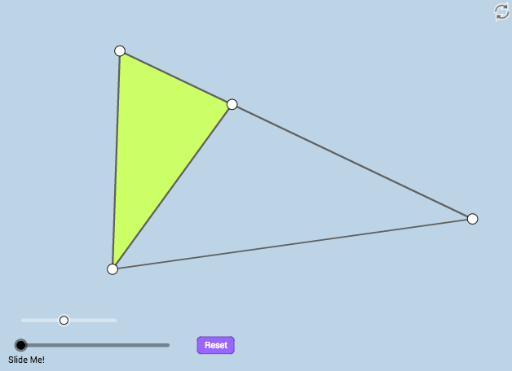
Loading the math board and drawing, please wait…
This example dynamically illustrates a theorem involving a triangle, circumcircle, and three angles. Key math concepts include circumcircle, angles, similarity transformation, and equations. Construction highlights the use of commands like Line, Rotate, Angle, Ray, Segment, Point, Polygon, Circle, Center, Intersect, CircleArc, Min, CircleSector, Dilate, Vector, and Translate in GeoGebra. Suitable for high school mathematics students and teachers for visualizing geometric theorems and exploration.
GeoGebra Commands & Parameters
Line(A, B) → fRotate(B, (a * π / 180), A) → B'Angle(B, A, B') → αRay(A, B') → gSegment(A, B) → hPoint(g) → CSegment(A, C) → iSegment(C, B) → jPoint(j) → DPolygon(A, C, D) → poly1, d, a_1, cCircle(A, D, C) → eCenter(e) → EAngle(B, A, D) → βRotate(B, β / 2, A) → B'_1Angle(B, A, B'_1) → γRay(A, B'_1) → kIntersect(e, k, 2) → FIntersect(j, k) → GRay(C, F) → lIntersect(h, l) → HSegment(G, H) → mSegment(D, H) → nSegment(D, F) → pAngle(F, D, H) → δAngle(F, C, D) → εAngle(G, H, D) → ζRotate(D, If[0 < b ≤ 2, (b * π), (2 * π)], E) → D'CircleArc(E, D, D') → qSegment(A, D) → rSegment(A, F) → sSegment(A, H) → tMin({r, s, t}) → oCircle(A, (0.25 * o)) → c_1Intersect(h, t) → IIntersect(h, t) → JIntersect(h, t) → KIntersect(c_1, s) → L,Intersect(c_1, h) → M,CircleSector(A, M, L) → d_1Dilate(A, If[2 < b ≤ 3, 3 - b, 0], F) → A'Intersect(l, r) → NSegment(C, N) → f_1Min({f_1, p, n, m}) → uCircle(C, (0.35 * u)) → e_1Circle(D, (0.35 * u)) → g_1Segment(A, A') → h_1Dilate(F, If[3 < b ≤ 4, 4 - b, 0], G) → F'Segment(F, F') → i_1Dilate(C, If[4 < b ≤ 5, 5 - b, 0], F) → C'Segment(C, C') → j_1Dilate(F, If[5 < b ≤ 6, 6 - b, 0], H) → F'_1Segment(F, F'_1) → k_1Intersect(e_1, j_1, 1) → OIntersect(e_1, j, 1) → PCircleSector(C, O, P) → p_1Intersect(g_1, p, 1) → QIntersect(g_1, n, 1) → RCircleSector(D, Q, R) → q_1Rotate(d_1, If[6 < b ≤ 7, ((b - 6) * γ), γ], A) → r_1Dilate(D, If[7 < b ≤ 8, 8 - b, 0], F) → D'_1Dilate(D, If[7 < b ≤ 8, 8 - b, 0], H) → D'_2Segment(D, D'_1) → l_1Segment(D, D'_2) → m_1Dilate(H, If[8 < b ≤ 9, 9 - b, 0], G) → H'Segment(H, H') → n_1Line(C, n_1) → s_1Intersect(e_1, s_1, 2) → SAngle(O, C, S) → θDilate(C, If[10 < b ≤ 11, 11 - b, 0], H) → C'_1Vector(C, C'_1) → vTranslate(p_1, v) → t_1Rotate(t_1, If[11 < b ≤ 12, ((b - 11) * θ), θ], H) → c_2Line(H, D) → b_1Dilate(D, If[12 < b ≤ 13, 13 - b, 0], H) → D'_3Vector(D, D'_3) → wTranslate(q_1, w) → d_2Rotate(d_2, If[13 < b ≤ 14, ((-(b - 13)) * π), (-π)], H) → e_2