
Dynamic Demonstration of a Phenomenon When Two Medians of a Triangle Are Perpend
Loading the math board and drawing, please wait…
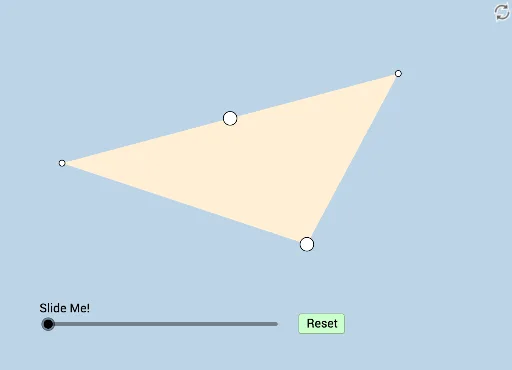
This example dynamically illustrates the geometric phenomenon that occurs when any two medians of a triangle are perpendicular. It involves core mathematical concepts such as medians, perpendicularity, vectors, and polygon construction. The construction utilizes GeoGebra commands and objects like Segment, Circle, Intersect, OrthogonalLine, Ray, Distance, Min, Polygon, Dilate, Rotate, CircleSector, Line, Point, Angle, Vector, and Translate. It is suitable for high school and above students to explore special triangle properties and dynamic geometric transformations.
GeoGebra Commands & Parameters
Segment(A, B) → fCircle(A, (2 * f / 3)) → cIntersect(c, f) → C,OrthogonalLine(C, f) → gCircle(C, 2) → dIntersect(d, g, 2) → DSegment(D, C) → hCircle(C, (2 * h)) → eIntersect(e, g, 1) → ESegment(C, E) → iRay(A, D) → jRay(E, B) → kIntersect(j, k) → FDistance(A, D) → distanceADDistance(D, F) → distanceDFDistance(B, F) → distanceBFDistance(B, E) → distanceBEDistance(C, F) → distanceCFDistance(A, E) → distanceAESegment(C, B) → lMin(h, l) → aCircle(C, (0.4 * a)) → pSegment(A, B) → mIntersect(p, m) → G, HPolygon(A, E, F) → t1, f_1, a_1, e_1Dilate(A, If[0 < b ≤ 1, 1 - b, 0], D) → A'Dilate(E, If[2 < b ≤ 3, 3 - b, 0], B) → E'Segment(A, A') → nRotate(A, If[1 < b ≤ 2, ((b - 1) * π), π], D) → A'_1Rotate(A', If[1 < b ≤ 2, ((b - 1) * π), π], D) → A''Segment(A'_1, A'') → n'Segment(E, E') → qRotate(E, If[3 < b ≤ 4, ((-(b - 3)) * π), (-π)], B) → E'_1Rotate(E', If[3 < b ≤ 4, ((-(b - 3)) * π), (-π)], B) → E''Segment(E'_1, E'') → q'Dilate(E, If[4 < b ≤ 5, 5 - b, 0], D) → E'_2Segment(E, E'_2) → rDilate(A, If[5 < b ≤ 6, 6 - b, 0], C) → A'_2Segment(A, A'_2) → sDilate(C, If[6 < b ≤ 7, 7 - b, 0], B) → C'Segment(C, C') → tRotate(H, If[7 < b ≤ 8, ((b - 7) * π / 2), π / 2], C) → H'CircleSector(C, H, H') → c_1Rotate(c_1, If[9 < b ≤ 10, ((b - 9) * π / 2), π / 2], C) → d_1Dilate(F, If[10.5 < b ≤ 11.5, 11.5 - b, 0], C) → F'Segment(F, F') → g_1Line(A, g_1) → h_1Point(h_1) → IAngle(E, A, I) → αDilate(C, If[12 < b ≤ 13, 13 - b, 0], A) → C'_1Vector(C, C'_1) → uTranslate(F, u) → F'_1Translate(F', u) → F''Segment(F'_1, F'') → i_1Rotate(F'_1, If[13 < b ≤ 14, ((-(b - 13)) * α), (-α)], A) → JRotate(F'', If[13 < b ≤ 14, ((-(b - 13)) * α), (-α)], A) → F'''Segment(J, F''') → j_1
AI Drawing Prompt Reference
Draw a triangle where two medians are perpendicular. Start with a base segment, construct a perpendicular line at a point on it, and use circle intersections to determine the third vertex. Connect vertices to midpoints of opposite sides to form medians, which intersect at the centroid. Animate the centroid moving along a median to show shape changes, label side and median lengths, and use circular sectors and rotating segments to illustrate the right angle relationship.
The prompt above was compiled from the original drawing commands and is for reference only.