
Double Reflection over Intersecting Lines by Katie Drach (2)
Loading the math board and drawing, please wait…
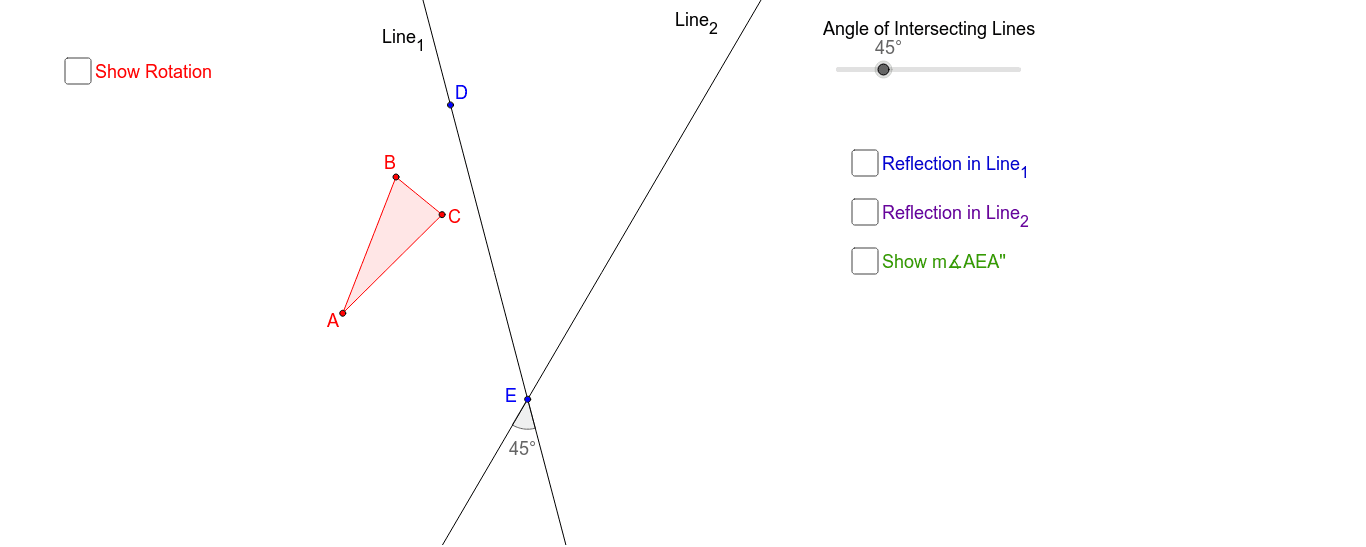
This example demonstrates the path and properties of points or shapes after undergoing double reflection over two intersecting lines. It involves core mathematical concepts such as reflection transformations, angle bisector properties, similarity transformations, and intersection geometry. The construction utilizes GeoGebra commands like polygon, line, rotation, mirror, and angle measurement. Suitable for high school and above students studying geometric transformations, coordinate geometry, and spatial reasoning.
GeoGebra Commands & Parameters
Polygon(A, B, C) → poly1, c, a, bLine(D, E) → Line_1Rotate(Line_1, (-α), E) → Line_2Mirror(A, Line_1) → A'Mirror(B, Line_1) → B'Mirror(C, Line_1) → C'Polygon(A', B', C') → poly1', c', a', b'Mirror(A', Line_2) → A''Mirror(B', Line_2) → B''Mirror(C', Line_2) → C''Polygon(A'', B'', C'') → poly1'', c'', a'', b''Angle(Line_2, Line_1) → βAngle(A'', E, A) → γSegment(E, A'') → eSegment(E, A) → fRotate(A, (-Rotation), E) → A'_1Rotate(B, (-Rotation), E) → B'_1Rotate(C, (-Rotation), E) → C'_1Polygon(A'_1, B'_1, C'_1) → poly1'_1, c'_1, a'_1, b'_1Segment(A, E) → iSegment(E, A'_1) → jAngle(A'_1, E, A) → δ