
Double Number Line for Percent Change
Loading the math board and drawing, please wait…
In collections
Percent Change App Collection
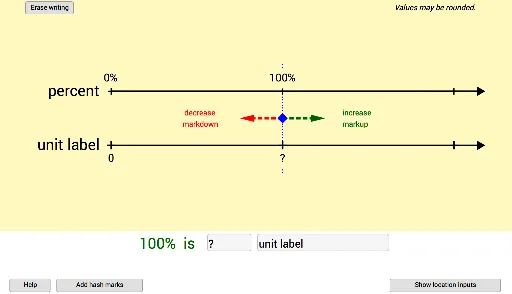
This example demonstrates a double number line for percent change, ranging from 0 to 200%. Users can adjust the whole value range from 0.1 to 100. GeoGebra commands such as If, Point, Segment, Textfield are used to dynamically show the process of percent change. Suitable for middle school and above students to learn about percent change.
GeoGebra Commands & Parameters
If(q2 < 100, 100, If[q2 < 500, 10, 1]) → roundingFactorDNL2valuesPoint(Segment[(0, 0.85), (4.3, 0.85)]) → slidePtIf(q2 ≥ 0 ∧ q2 ≤ 0.1, 0.1, round((roundingFactorDNL2values * q2)) / roundingFactorDNL2values) → q2rndIf(q1 < 100, 100, If[q1 < 500, 10, 1]) → roundingFactorDNL1valuesIf(q1 ≥ 0 ∧ q1 ≤ 0.1, 0.1, If[q1 < 25, round((100 * q1)) / 100, If[q1 < 75, round((10 * q1)) / 10, If[q1 > 100, 100, round(q1)]]]) → q1rndSegment(A, DNL2ArrowPt) → lineDNL1Segment(B, DNL1ArrowPt) → lineDNL2If(hatchMinor ≟ 3 ∨ hatchMinor ≟ 6 ∨ hatchMinor ≟ 7 ∨ hatchMinor ≟ 9, -0.2, -0.15) → topxOffSetTextfield(q2labelForLengthAlwaysShow) → q2blabelInputSegment(slidePt + (0, 1.7), slidePt - (0, 1.75)) → slideSegText(0, (x(A) - 0.035, y(A) - (1.7 * yOffSet))) → zeroDNL2Sequence(((length * k), 0), k, 0, 4, 2) → hashMajorDNL2Sequence(((length * k), h), k, 0, 4, 2) → hashMajorDNL1Sequence((k, h), k, 0, 4.3, ((2 * length)) / hatchMinor) → hashMinorDNL1Sequence((k, 0), k, 0, 4.3, ((2 * length)) / hatchMinor) → hashMinorDNL2Text("0%", (x(B) - 0.087, y(B) + yOffSet)) → zeroDNL1Sequence(Text[(50 * q) + "%", ((length * q) + topxOffSet, y(B) + yOffSet)], q, If[hatchMinor ≟ 7 ∨ hatchMinor ≟ 9, 6 / hatchMinor, If[hatchMinor ≤ 5, 2 / hatchMinor, 4 / hatchMinor]], If[hatchMinor ≟ 3 ∨ hatchMinor ≟ 6 ∨ hatchMinor ≟ 9, 3.5, 4], If[hatchMinor ≟ 7 ∨ hatchMinor ≟ 9, 6 / hatchMinor, If[hatchMinor ≤ 5, 2 / hatchMinor, 4 / hatchMinor]]) → hashMarkValuesTextDNL1Polygon((1.5, 1.9), (2.2, 1.9), (2.2, 2.3), (1.5, 2.3)) → dnl1HatchMinorHide, f, g, i, jSequence(Text[((0.5 * p) * q2), ((length * p) + xOffSet, y(A) - (1.7 * yOffSet))], p, If[hatchMinor ≟ 7 ∨ hatchMinor ≟ 9, 6 / hatchMinor, If[hatchMinor ≤ 5, 2 / hatchMinor, 4 / hatchMinor]], 4, If[hatchMinor ≟ 7 ∨ hatchMinor ≟ 9, 6 / hatchMinor, If[hatchMinor ≤ 5, 2 / hatchMinor, 4 / hatchMinor]]) → hashMarkValuesTextDNL2Mirror(dnl1HatchMinorHide, y = h / 2) → dnl2HatchMinorHideVector(((2 * length), (0.5 * h)), If[slidePtMovedCk, slidePt - (0.03, 0), slidePt + (0.5, 0)]) → markUpArrowVector(((2 * length), (0.5 * h)), If[slidePtMovedCk, slidePt + (0.03, 0), slidePt - (0.5, 0)]) → markDownArrowTextfield(q2inputTextToParse) → q2avalueInputTextfield(locationXq2InputTextToParse) → locationXq2InputTextfield(locationXq1InputTextToParse) → locationXq1Input