
Dodecahedron as a Planar Graph
Loading the math board and drawing, please wait…
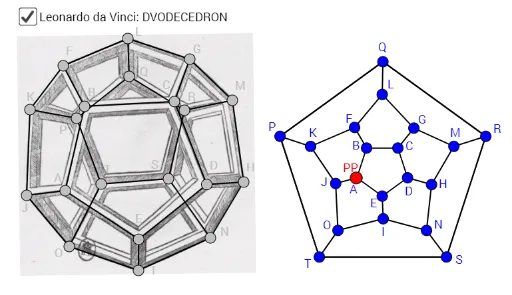
This example demonstrates how to represent a regular dodecahedron (a Platonic solid) as a planar graph, showing its vertices and edges in a two-dimensional layout. The core mathematical concepts include solid geometry, regular polyhedra, planar graphs, and graph theory elements such as vertices, edges, and faces. The construction uses GeoGebra commands Segment, Polygon, and Point, creating multiple point objects (e.g., G_1, H_1, C_2, etc.) and connecting them with segments and polygons to form the planar network of the dodecahedron. This is suitable for high school or university students learning about solid geometry, graph theory, or mathematical visualization, helping them understand how 3D objects can be represented in 2D.
GeoGebra Commands & Parameters
Segment(G_1, H_1) → aSegment(E_2, G_1) → bSegment(E_2, F_1) → cSegment(F_1, I_1) → dSegment(I_1, H_1) → eSegment(F_1, L_2) → fSegment(J_1, I_1) → gSegment(L_2, M_2) → hSegment(M_2, N_1) → iSegment(N_1, E_2) → jSegment(T_1, M_2) → kSegment(T_1, S_1) → lSegment(S_1, O_1) → mSegment(O_1, P_1) → nSegment(P_1, G_1) → pSegment(Q_1, P_1) → qSegment(Q_1, R_1) → rSegment(S_1, W) → sSegment(W, Q_1) → tSegment(R_1, Z) → a_1Segment(Z, V) → b_1Segment(V, W) → c_1Segment(U, V) → d_1Segment(U, T_1) → e_1Segment(U, K_2) → f_1Segment(K_2, J_1) → g_1Segment(Z, J_1) → h_1Segment(K_2, L_2) → i_1Segment(R_1, H_1) → j_1Segment(O_1, N_1) → k_1Polygon(T, S, 5) → veelhoek1, vc, vd, ve, va, vb, R, Q, PPolygon(C, B, 5) → veelhoek2, vq, vg, vh, vi, vj, A, E, DPolygon(O, N, 5) → veelhoek3, h_2, i_2, j_2, k_2, l_2, M, L, KPolygon(G, F, 5) → veelhoek4, m_2, n_2, p_2, q_2, r_2, J, I, HSegment(P, K) → vbbSegment(Q, L) → vaaSegment(R, M) → vkSegment(S, N) → vuSegment(T, O) → vccSegment(K, F) → vnSegment(F, L) → voSegment(L, G) → vmSegment(G, M) → vlSegment(M, H) → vsSegment(H, N) → vtSegment(N, I) → vvSegment(I, O) → vwSegment(O, J) → vxSegment(J, K) → vySegment(J, A) → vzSegment(I, E) → vddSegment(H, D) → vfSegment(G, C) → vrSegment(B, F) → vpPoint(ribben) → PP
AI Drawing Prompt Reference
Draw a planar graph representation of a regular dodecahedron, showing its vertices and edges in a two-dimensional layout. The graph consists of multiple vertices connected by line segments, forming pentagonal faces. Arrange several pentagons as basic units, with adjacent pentagons sharing edges or vertices. Connect the vertices of different pentagons with additional line segments to create a complete connected network. The final figure is a planar graph that illustrates the topological structure of a dodecahedron.
The prompt above was compiled from the original drawing commands and is for reference only.