
Discriminant and Its Effects on Roots
Loading the math board and drawing, please wait…
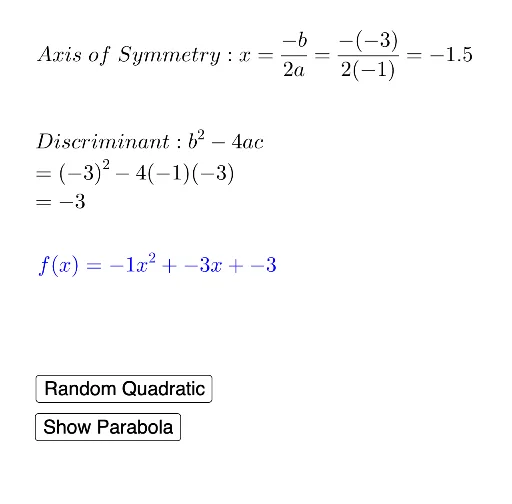
This GeoGebra example dynamically illustrates how the discriminant of a quadratic function affects the number and nature of its roots. It demonstrates the transition between two distinct real roots, one repeated real root, and two complex roots as the discriminant varies. Core mathematical concepts include the discriminant formula, root properties, real vs. complex roots, and quadratic function behavior. Construction uses GeoGebra commands such as Random, Root, and LaTeX to generate random coefficients, compute roots dynamically, and display them with formatted text and interactive buttons. Suitable for high school algebra, pre-calculus, or introductory complex numbers units, it serves well for classroom demonstration or student exploration of root behavior.
GeoGebra Commands & Parameters
Random(-6, 6) → bRandom(-6, 6) → cRandomElement({-3, -2, -1, 1, 2, 3}) → aRoot(f) → A, BLaTeX($3) → text2LaTeX($4) → text3
AI Drawing Prompt Reference
Draw a quadratic function graph where the coefficient a is randomly chosen from -3 to 3, and the coefficients b and c are randomly chosen from -6 to 6. Dynamically show how the number and nature of the roots change as a, b, and c vary, including two real roots, one repeated real root, and two complex roots.
The prompt above was compiled from the original drawing commands and is for reference only.