
Directional Derivatives Interactive Demonstration
Loading the math board and drawing, please wait…
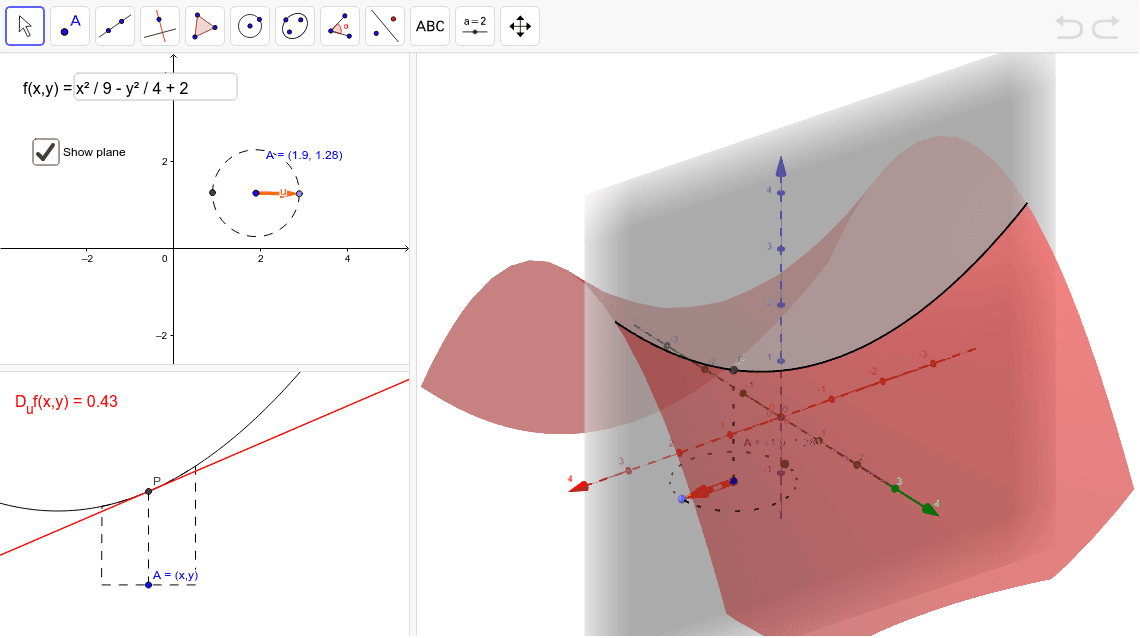
This GeoGebra example demonstrates the concept of directional derivatives, which is the rate of change of a function in a specific direction. It visually shows the function graph, direction vector, and tangent slope to illustrate the geometric meaning. Core math concepts include derivatives, directional derivatives, partial derivatives, gradient vectors, cosine functions (for direction cosines), conic sections, logarithmic functions, sequences and series, and perimeter calculations. In terms of construction, it uses commands like Textfield for text input, Segment for drawing lines, Circle for circles, Point for points, Vector for direction vectors, IntegralBetween for integral areas, Tangent for tangents, Slope for slopes, CurveCartesian for Cartesian curves, and Plane for planes. Objects such as point A, function f, input box, point P, parameters a and c, points B and u, C and D with distance d, E and e, height h, functions g and i, F and j, k, directional derivative function duf, G and l, text, parameters b, p, m, n are used to create an interactive environment. It is suitable for university calculus, multivariable function analysis, or related math courses for teaching and self-study.
GeoGebra Commands & Parameters
Textfield(f) → inputBox1Segment(P, A) → aCircle(A, 1) → cPoint(c) → BVector(A, B) → uSegment(D, B) → dSegment(E, D) → eIntegralBetween(f(x(A) + (x * x(u)), y(A) + (x * y(u))), 0, -1, 1) → hTangent(0, g) → iSegment(C, B) → jCircle(A, B) → kSlope(i) → dufSegment(F, G) → lCurveCartesian(x(A) + (t * x(u)), y(A) + (t * y(u)), f(x(A) + (t * x(u)), y(A) + (t * y(u))), t, -10, 10) → bPlane(A, B, P) → m
AI Drawing Prompt Reference
Draw a 3D coordinate system with a surface representing a two-variable function. Mark a base point on the surfacehol and place a unit circle centered at its projection, with a movable point on the circle. Create a direction vector from the base point to this movable point. Along this direction, trace a curve on the surface and draw its tangent line at the base point, displaying the slope value. Also connect auxiliary points with line segments and include a plane passing through the base point, the direction vector endpoint, and another surface point to illustrate the geometry of directional derivatives.
The prompt above was compiled from the original drawing commands and is for reference only.