
Coordinates of a Point in Space
Loading the math board and drawing, please wait…
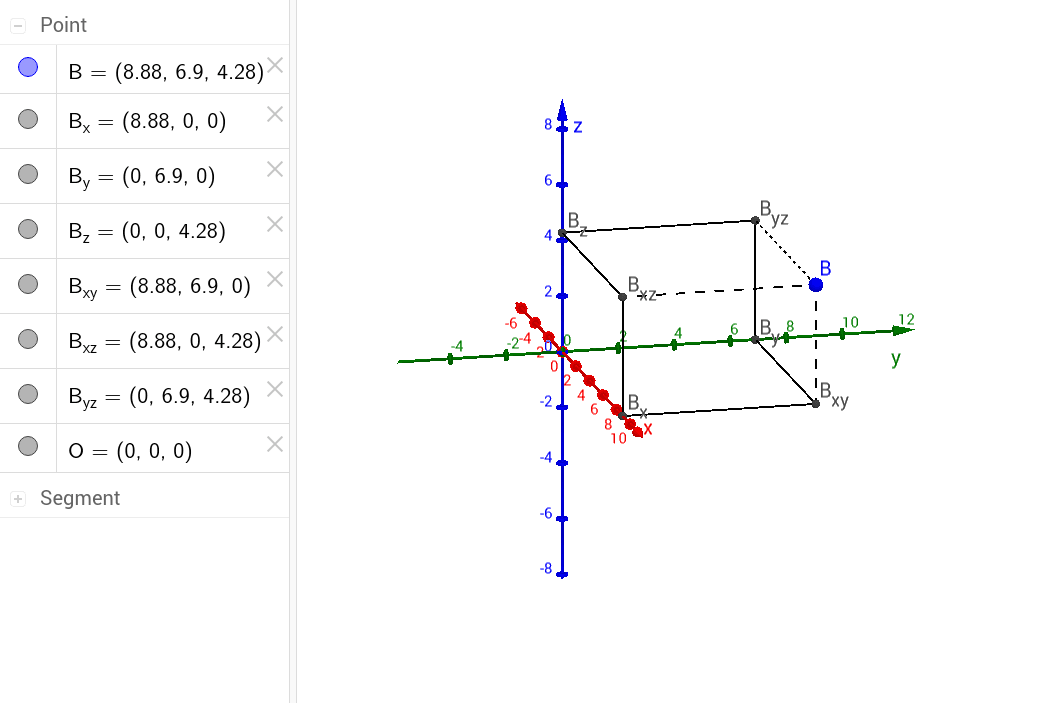
This example demonstrates how to determine the coordinates of a point in three-dimensional space. It involves core mathematical concepts such as the Cartesian coordinate system in space, coordinate representation of points, and vector operations. The construction uses GeoGebra commands like Point and Segment, and objects including B, B_{yz}, B_{xy}, B_{xz}, a, b, c, B_z, B_y, B_x, d, e, f, g, h, i, O. It is suitable for high school and introductory university students learning spatial geometry and vector applications.
GeoGebra Commands & Parameters
Point({0, y(B), z(B)}) → B_{yz}Point({x(B), y(B), 0}) → B_{xy}Point({x(B), 0, z(B)}) → B_{xz}Segment(B, B_{xy}) → aSegment(B, B_{xz}) → bSegment(B, B_{yz}) → cPoint({0, 0, z(B)}) → B_zPoint({0, y(B), 0}) → B_yPoint({x(B), 0, 0}) → B_xSegment(B_{xz}, B_z) → dSegment(B_{xz}, B_x) → eSegment(B_{xy}, B_x) → fSegment(B_{xy}, B_y) → gSegment(B_{yz}, B_y) → hSegment(B_{yz}, B_z) → iPoint({0, 0, 0}) → O