
Dilations Overview
Loading the math board and drawing, please wait…
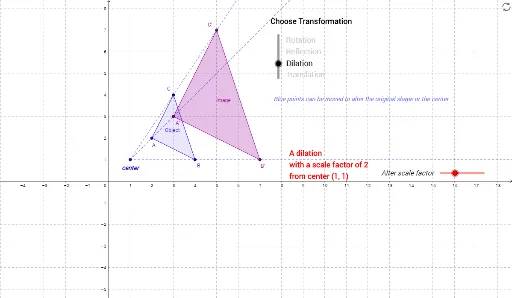
This example illustrates the concept of dilations in geometry. It involves using GeoGebra commands such as Dilate (scaling), Ray (ray), Translate (translation), etc., to demonstrate how to change the size and position of a figure through scaling, translation, and rotation. Suitable for students at the middle school level and above learning geometric transformations.
GeoGebra Commands & Parameters
Polygon(C, A, B) → poly1, b, c, dDilate(C, a, I) → C'Dilate(A, a, I) → A'Dilate(B, a, I) → B'Polygon(C', A', B') → poly1'_1, b', c', d'Ray(I, C) → eRay(I, B) → fRay(I, A) → gTranslate(C, Vector[(horz, vert)]) → C'_2Translate(A, Vector[(horz, vert)]) → D'_2Translate(B, Vector[(horz, vert)]) → B'_2Polygon(C'_2, D'_2, B'_2) → poly1'_2, b'_1, c'_1, d'_1Vector(C, C'_2) → uVector(B, B'_2) → vVector(A, D'_2) → wRotate(C, (-α), I) → C'_3Rotate(A, (-α), I) → D'_3Rotate(B, (-α), I) → B'_3Polygon(C'_3, D'_3, B'_3) → poly1'_3, b'_2, c'_2, d'_2Point(xAxis) → ELine(F, E) → hMirror(C, h) → KMirror(A, h) → D'Mirror(B, h) → JPolygon(K, D', J) → poly1', b'_3, c'_3, d'_3Vector(I, G) → zAngle(G, I, H) → β