
Dilating a Line by Tim Brzezinski
Loading the math board and drawing, please wait…
In collections
Geometry Review
Similarity & Right Triangle Trigonometry
Similarity, Right Triangles, and Trigonometry (SRT) Cluster
Transformations! (Geometry)
Dilations: Discovery Activities & Exercises
Dilations: Discovery Activities & Exercises
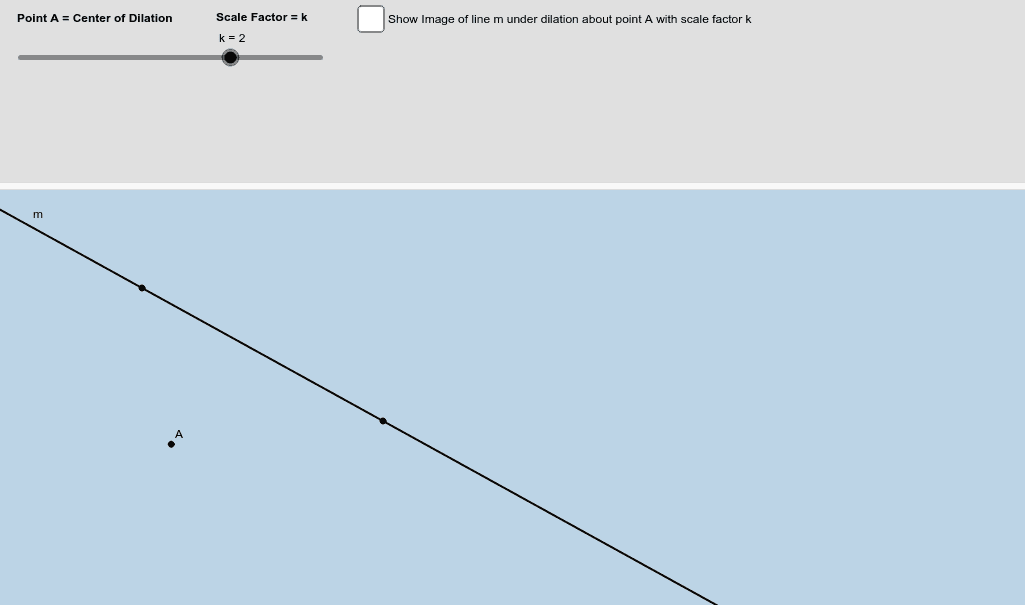
This example demonstrates how a line not passing through the center of dilation transforms under similarity transformation, specifically showing the scaling effect on line segments. Key math concepts include similarity transformation, dilation, central symmetry, and segment proportionality. GeoGebra commands used are Line, Dilate, Intersect, Circle, CircleSector, Angle, Vector, and Translate. Suitable for high school mathematics students to explore the properties and applications of similarity transformations.
GeoGebra Commands & Parameters
Line(B, C) → mDilate(m, k, A) → m'Intersect(m, t) → OLine(A, C) → fCircle(C, 2) → gIntersect(m', f) → ECircle(E, 2) → hIntersect(g, m, 2) → FIntersect(g, f, 2) → GIntersect(h, m', 2) → HIntersect(h, f, 2) → IIntersect(g, m, 1) → JIntersect(g, f, 1) → KCircleSector(C, F, G) → qAngle(F, C, G) → αAngle(J, C, G) → βCircleSector(C, J, G) → cIntersect(h, m', 1) → NDilate(C, 1 - i, E) → C'Vector(C, C') → uTranslate(q, u) → q'Translate(c, u) → c'Circle(A, 2) → e
AI Drawing Prompt Reference
Draw a line not passing through the center to demonstrate its transformation under similarity, showing scaling effects. First, perform a similarity transformation on the line around a center point. Then, draw a circle centered at the center point, intersecting with the transformed and original lines to find key points. Next, draw circles using these points and find their intersections. Finally, use arcs and vectors to illustrate the geometric properties of the similarity transformation.
The prompt above was compiled from the original drawing commands and is for reference only.