
Determining Function Invertibility and Values
Loading the math board and drawing, please wait…
In collections
UCSS Secondary Math III Unit 4A Lesson 1
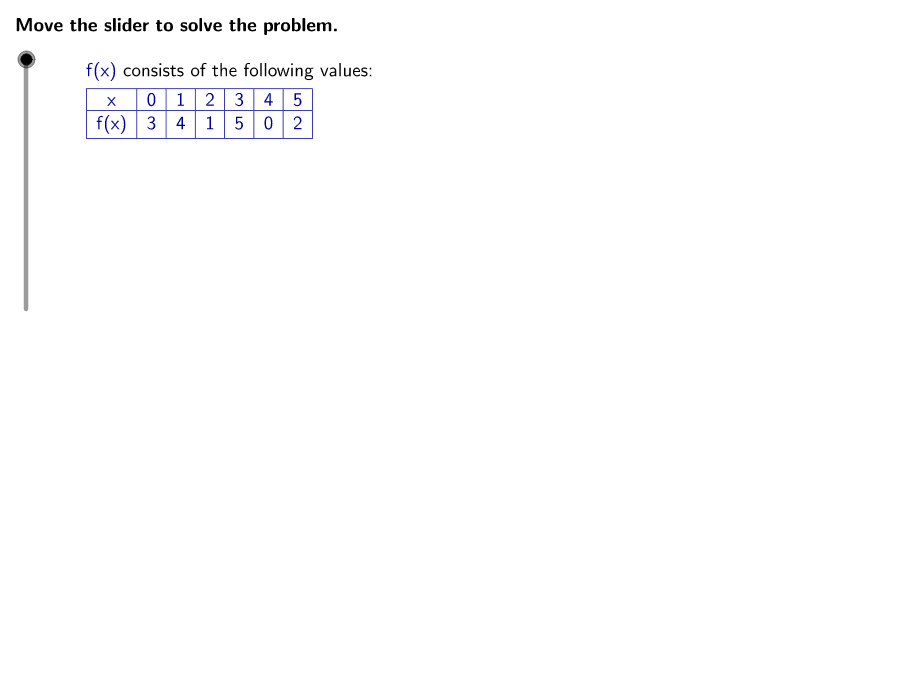
This example demonstrates how to determine if a function represented in a table is invertible and to find specific function values using the table. Key math concepts include function invertibility and its determination criteria. GeoGebra commands and objects like Element, IndexOf, LaTeX, Corner, TableText, If are used to construct and manipulate the table, function representation, and conditional logic. Suitable for high school students learning about function properties and GeoGebra applications.
GeoGebra Commands & Parameters
Element(common, 3) → v3IndexOf(v3, functionvalues) → p3Element(common, 2) → v2IndexOf(v2, xvalues) → p2Element(common, 1) → v1IndexOf(v1, xvalues) → p1LaTeX(steps) → counterLaTeX("\text{Use the buttons below to return to the original problem or}\cr\text{randomly generate a similar practice problem.}") → RandomizationTextCorner(1) → ACorner(3) → BTableText({Append["x", xvalues], Append["f(x)", functionvalues]}, "c|_") → dataLaTeX("\text{Determine whether the inverse function }\textcolor{#000099}{f^{–1}(x)}\text{ exists.}") → text1LaTeX("\text{To determine whether a function is invertible, check to see if any }\textcolor{#000099}{x}\text{- or }\textcolor{#000099}{y}\text{-values}\cr\text{have been used more than once.}") → text2LaTeX("\text{The function represented in the table repeats an }\textcolor{#000099}{x}\text{- value, so the function is not}\cr\text{“one-to-one” and is not invertible. The inverse }\textcolor{#000099}{f^{-1}(x)}\text{ does not exist.}") → text3bIf(Length[xvalues] ≟ Length[Unique[xvalues]], "y", "n") → xuniqueLaTeX("\text{The function represented in the table repeats a }\textcolor{#000099}{y}\text{- value, so the function is not}\cr\text{“one-to-one” and is not invertible. The inverse }\textcolor{#000099}{f^{-1}(x)}\text{ does not exist.}") → text3cLaTeX("\text{The function represented in the table repeats an }\textcolor{#000099}{x}\text{- and a }\textcolor{#000099}{y}\text{-value, so the}\cr\text{function is not “one-to-one” and is not invertible. The inverse }\textcolor{#000099}{f^{-1}(x)}\text{ does not}\cr\text{exist.}") → text3dIf(Length[functionvalues] ≟ Length[Unique[functionvalues]], "y", "n") → inverseuniqueLaTeX("\text{The function represented in the table does not repeat any }\textcolor{#000099}{x}\text{-values or any }\cr\textcolor{#000099}{y}\text{-values, so the function is “one-to-one” and is invertible. The inverse }\textcolor{#000099}{f^{–1}(x)}\cr\text{exists.}") → text3aIf(xunique ≟ "y", If[inverseunique ≟ "y", LaTeX[text3a], LaTeX[text3c]], If[inverseunique ≟ "y", LaTeX[text3b], LaTeX[text3d]]) → text3Element(common, 4) → v4Element(functionvalues, p1) → m1LaTeX((("\text{Find the function value }\textcolor{#000099}{f(" * v1) * ")}.")) → text4Element(xvalues, p3) → m3Element(functionvalues, p2) → m2LaTeX((("\text{Find the function value }\textcolor{#000099}{f(" * v2) * ")}.")) → text7LaTeX((((((((((((((("\text{To find the value of }\textcolor{#000099}{f(x)}\text{ at }\textcolor{#000099}{x=" * v1) * "}\text{, locate the value }\textcolor{#000099}{") * v1) * "}\text{ in the }\textcolor{#000099}{x}\text{ row of the table.}\cr\text{The value }\textcolor{#000099}{") * m1) * "}\text{ directly below }\textcolor{#000099}{x = ") * v1) * "}\text{ is the value of }\textcolor{#000099}{f(x)}\text{ at }\textcolor{#000099}{x = ") * v1) * "}\text{. That is, }\textcolor{#000099}{f(") * v1) * ") = ") * m1) * "}.")) → text5LaTeX((((((((((((((("\text{To find the value of }\textcolor{#000099}{f(x)}\text{ at }\textcolor{#000099}{x=" * v2) * "}\text{, locate the value }\textcolor{#000099}{") * v2) * "}\text{ in the }\textcolor{#000099}{x}\text{ row of the table.}\cr\text{The value }\textcolor{#000099}{") * m2) * "}\text{ directly below }\textcolor{#000099}{x = ") * v2) * "}\text{ is the value of }\textcolor{#000099}{f(x)}\text{ at }\textcolor{#000099}{x = ") * v2) * "}\text{. That is, }\textcolor{#000099}{f(") * v2) * ") = ") * m2) * "}.")) → text8LaTeX((("\text{Find the inverse function value }\textcolor{#000099}{f^{-1}(" * v3) * ")}.")) → text10IndexOf(v4, functionvalues) → p4Element(xvalues, p4) → m4TableText({Join[{{LaTeX["\textcolor{#000099}{x}"]}, Sequence[LaTeX[(("\textcolor{#000099}{" * Element[xvalues, i]) * "}")], i, 1, p1 - 1], {LaTeX[(("\textcolor{#CC0000}{" * Element[xvalues, p1]) * "}")]}, Sequence[LaTeX[(("\textcolor{#000099}{" * Element[xvalues, i]) * "}")], i, p1 + 1, 6]}], Join[{{LaTeX["\textcolor{#000099}{f(x)}"]}, Sequence[LaTeX[(("\textcolor{#000099}{" * Element[functionvalues, i]) * "}")], i, 1, p1 - 1], {LaTeX[(("\textcolor{#CC0000}{" * Element[functionvalues, p1]) * "}")]}, Sequence[LaTeX[(("\textcolor{#000099}{" * Element[functionvalues, i]) * "}")], i, p1 + 1, 6]}]}, "c|_") → text6TableText({Join[{{LaTeX["\textcolor{#000099}{x}"]}, Sequence[LaTeX[(("\textcolor{#000099}{" * Element[xvalues, i]) * "}")], i, 1, p2 - 1], {LaTeX[(("\textcolor{#CC0000}{" * Element[xvalues, p2]) * "}")]}, Sequence[LaTeX[(("\textcolor{#000099}{" * Element[xvalues, i]) * "}")], i, p2 + 1, 6]}], Join[{{LaTeX["\textcolor{#000099}{f(x)}"]}, Sequence[LaTeX[(("\textcolor{#000099}{" * Element[functionvalues, i]) * "}")], i, 1, p2 - 1], {LaTeX[(("\textcolor{#CC0000}{" * Element[functionvalues, p2]) * "}")]}, Sequence[LaTeX[(("\textcolor{#000099}{" * Element[functionvalues, i]) * "}")], i, p2 + 1, 6]}]}, "c|_") → text9TableText({Join[{{LaTeX["\textcolor{#000099}{x}"]}, Sequence[LaTeX[(("\textcolor{#000099}{" * Element[xvalues, i]) * "}")], i, 1, p3 - 1], {LaTeX[(("\textcolor{#CC0000}{" * Element[xvalues, p3]) * "}")]}, Sequence[LaTeX[(("\textcolor{#000099}{" * Element[xvalues, i]) * "}")], i, p3 + 1, 6]}], Join[{{LaTeX["\textcolor{#000099}{f(x)}"]}, Sequence[LaTeX[(("\textcolor{#000099}{" * Element[functionvalues, i]) * "}")], i, 1, p3 - 1], {LaTeX[(("\textcolor{#CC0000}{" * Element[functionvalues, p3]) * "}")]}, Sequence[LaTeX[(("\textcolor{#000099}{" * Element[functionvalues, i]) * "}")], i, p3 + 1, 6]}]}, "c|_") → text12LaTeX((("\text{Find the inverse function value }\textcolor{#000099}{f^{-1}(" * v4) * ")}.")) → text13TableText({Join[{{LaTeX["\textcolor{#000099}{x}"]}, Sequence[LaTeX[(("\textcolor{#000099}{" * Element[xvalues, i]) * "}")], i, 1, p4 - 1], {LaTeX[(("\textcolor{#CC0000}{" * Element[xvalues, p4]) * "}")]}, Sequence[LaTeX[(("\textcolor{#000099}{" * Element[xvalues, i]) * "}")], i, p4 + 1, 6]}], Join[{{LaTeX["\textcolor{#000099}{f(x)}"]}, Sequence[LaTeX[(("\textcolor{#000099}{" * Element[functionvalues, i]) * "}")], i, 1, p4 - 1], {LaTeX[(("\textcolor{#CC0000}{" * Element[functionvalues, p4]) * "}")]}, Sequence[LaTeX[(("\textcolor{#000099}{" * Element[functionvalues, i]) * "}")], i, p4 + 1, 6]}]}, "c|_") → text15LaTeX((((((((((((((("\text{To find the value of }\textcolor{#000099}{f^{-1}(" * v4) * ")}\text{, locate the value }\textcolor{#000099}{") * v4) * "}\text{ in the }\textcolor{#000099}{f(x)}\text{ row of the table.}\cr\text{The value }\textcolor{#000099}{") * m4) * "}\text{ directly above }\textcolor{#000099}{f(x) = ") * v4) * "}\text{ is the value of }\textcolor{#000099}{f^{-1}(") * v4) * ")}\text{. That is, }\textcolor{#000099}{f^{-1}(") * v4) * ") = ") * m4) * "}.")) → text14LaTeX("\text{Summarize your findings.}") → text16LaTeX((((((((((((((((("\text{As found using the table for }\textcolor{#000099}{f(x)}\text{, }\textcolor{#000099}{f(" * v1) * ")= ") * m1) * "}\text{, }\textcolor{#000099}{f(") * v2) * ") = ") * m2) * "}\text{, }\textcolor{#000099}{f^{–1}(") * v3) * ") = ") * m3) * "}\text{, and }\textcolor{#000099}{f^{–1}(") * v4) * ") = ") * m4) * "}.")) → text17If(inverseunique ≟ "y" ∧ xunique ≟ "y", stepMax, 4) → triggerLaTeX("\text{Move the slider to solve the problem.}") → text0LaTeX((("\textcolor{#000099}{f(x)}\text{ consists of the following values:}\cr\textcolor{#000099}{" * data) * "}")) → ProblemLaTeX((((((((((((((("\text{There are multiple ways to find an inverse function value. One way is to use the existing table.}\cr\text{To find the value of }\textcolor{#000099}{f^{-1}(" * v3) * ")}\text{, locate the value }\textcolor{#000099}{") * v3) * "}\text{ in the }\textcolor{#000099}{f(x)}\text{ row of the table.}\cr\text{The value }\textcolor{#000099}{") * m3) * "}\text{ directly above }\textcolor{#000099}{f(x) = ") * v3) * "}\text{ is the value of }\textcolor{#000099}{f^{-1}(") * v3) * ")}\text{. That is, }\textcolor{#000099}{f^{-1}(") * v3) * ") = ") * m3) * "}.")) → text11
AI Drawing Prompt Reference
Draw a function table showing x-values and corresponding f(x) values, highlighting a specific x and f(x) with a different color. Add text above the table explaining whether the function is invertible and why, such as repeating x or y values. Include text explaining how to find the f(x) value for a specific x, and how to find the inverse function value for a specific f(x). Finally, summarize the found function and inverse function values.
The prompt above was compiled from the original drawing commands and is for reference only.