
Deriving the Triangle Area Formula – IM 6.1.9 Activity 2
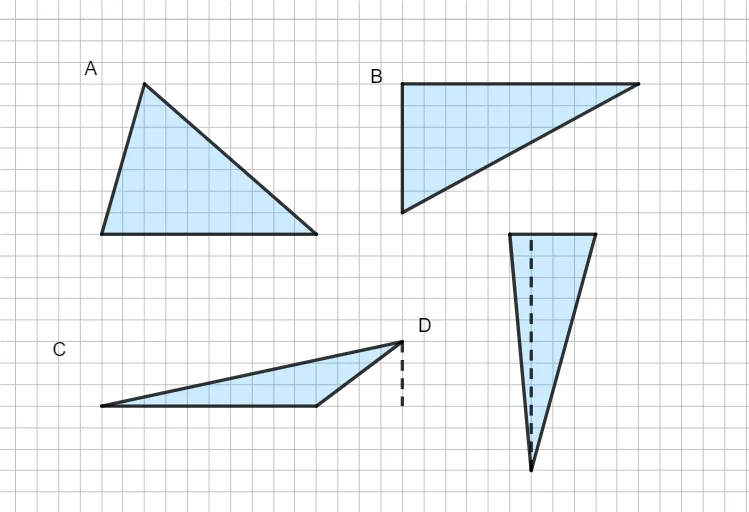
Loading the math board and drawing, please wait…
In collections
Grade 6 Unit 1: Area and Surface Area
This example demonstrates the derivation of the triangle area formula using dynamic geometry. By moving vertices A, B, and C, users can see how the base, height, and resulting area change in real time. The core mathematical concepts include the triangle area formula S = ½·base·height and its connections to unit circles, trapezoids, and other shapes. The construction uses GeoGebra commands such as Polygon to create the triangle, Segment for sides, Point for vertices, and sliders t1, t2, etc., to control variables. It is suitable for middle and high school teachers and students, especially in lessons combining geometric construction with algebraic reasoning.
GeoGebra Commands & Parameters
Polygon(A, B, C) → t1, c, a, bPolygon(D, E, F) → t2, f, d, ePolygon(G, H, I) → t3, i, g, hPolygon(J, K, L) → t4, l, j, kSegment(H, M) → mPoint(k) → NSegment(K, N) → n