
Deriving a Parabola via Focus and Directrix Trace
Loading the math board and drawing, please wait…
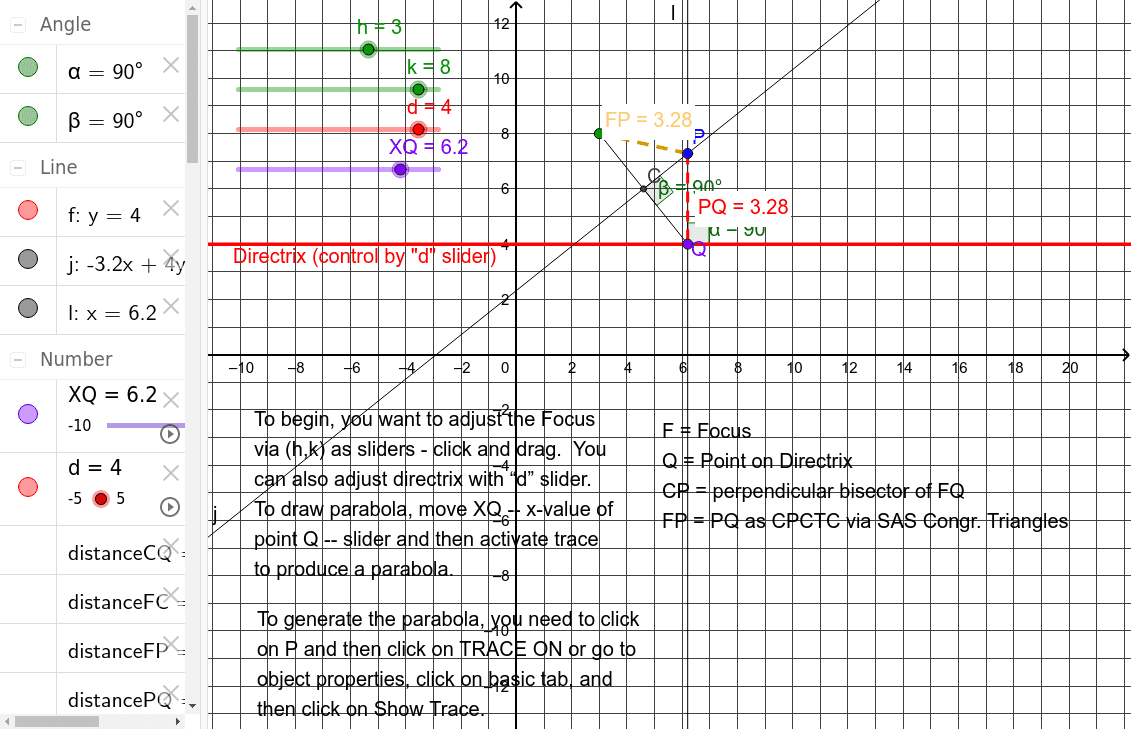
This example demonstrates the dynamic derivation of a parabola's definition using the trace of points equidistant from a focus and a directrix. Key math concepts include parabola definition, focus, directrix, distance, angle, and coordinate geometry. GeoGebra commands used are Segment, Midpoint, OrthogonalLine, Intersect, Distance, Angle; objects include h, k, F, d, f, XQ, Q, i, C, j, l, P, FP, distanceFP, TextFP, distancePQ, TextPQ, α, β, distanceFC, TextFC, distanceCQ, TextCQ, text1, PQ, text2, text3. Suitable for high school coordinate geometry instruction or exploration by math enthusiasts.
GeoGebra Commands & Parameters
Segment(F, Q) → iMidpoint(i) → COrthogonalLine(C, i) → jOrthogonalLine(Q, f) → lIntersect(j, l) → PSegment(F, P) → FPDistance(F, P) → distanceFPDistance(P, Q) → distancePQAngle(f, l) → αAngle(j, i) → βDistance(F, C) → distanceFCDistance(C, Q) → distanceCQSegment(P, Q) → PQ
AI Drawing Prompt Reference
Draw a parabola with focus F and directrix d. First, draw a segment i through F and Q. Then, find the midpoint C of i and draw a line j through C that is perpendicular to i. Draw another line l through Q that is perpendicular to the directrix d, and find their intersection point P. Draw segment FP, calculate the lengths of FP and PQ, and the angles α and β between FP and PQ with the directrix d. Finally, calculate the distances from F to C and from C to Q.
The prompt above was compiled from the original drawing commands and is for reference only.