
Derivative of Arctangent Function
Loading the math board and drawing, please wait…
In collections
BC Calculus
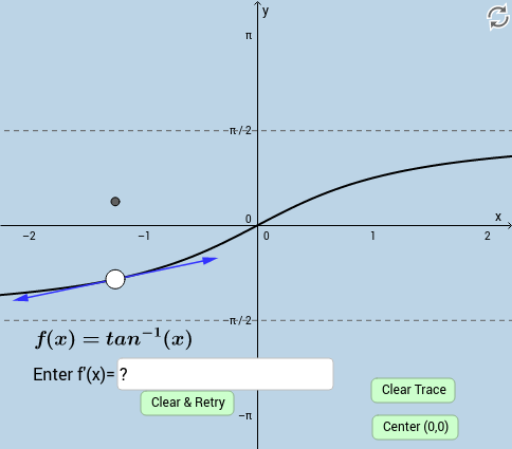
This example demonstrates the calculation and geometric interpretation of the derivative of the arctangent function f(x)=arctan(x). Key math concepts include derivatives, tangents, slopes, vectors, and trigonometry. Construction highlights involve using GeoGebra commands/objects like Point, Intersect, Circle, Tangent, Slope, Vector, and Textfield to build tangents, slope vectors, and function graphs. Suitable for high school calculus instruction and student exploratory learning.
GeoGebra Commands & Parameters
Point(p) → AIntersect(i, yAxis) → BIntersect(f, i, (-1.2324462406838077, 0.39699494892935805)) → CCircle(C, 1) → cTangent(C, f) → jIntersect(c, j, 1) → DSlope(j) → mIntersect(c, j) → F, GCircle(A, 0.9642295892450196) → dTangent(A, p) → kIntersect(d, k) → H, IVector(A, I) → uVector(A, H) → vTextfield(n) → InputBox1
AI Drawing Prompt Reference
Draw the graph of y=arctan(x) and illustrate its derivative geometrically. First, plot a tangent line and find its intersection with the x-axis. Then, determine the tangent's direction by finding the intersection points between the tangent and a circle centered at the point of tangency. Next, draw a circle centered at the point of tangency and find its other intersection with the tangent line. Calculate the slope of the tangent and draw a perpendicular radius from the point of tangency. Label the derivative value.
The prompt above was compiled from the original drawing commands and is for reference only.