
Derivative Minimum Problem - Part 2: Tangent Slope and Geometric Mean
Loading the math board and drawing, please wait…
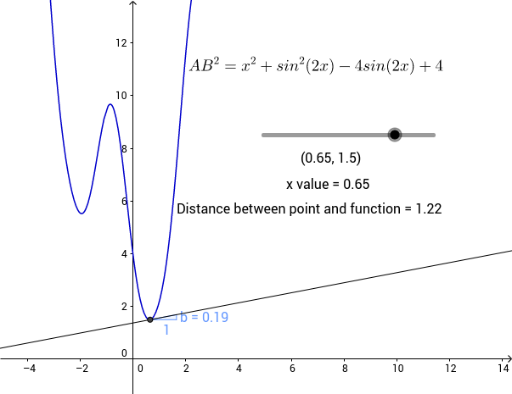
①This example demonstrates the second part of a derivative minimum problem, showing how to find the minimum of a derivative by dynamically constructing tangent lines and measuring their slopes on a function graph. ②Core mathematical concepts include derivatives, tangent slope, geometric mean, continuity, and optimization, with connections to logarithmic functions and distributions. ③Construction details: using GeoGebra commands Intersect to find intersection points, Tangent to draw tangent lines, and Slope to measure slopes; objects include function f, point A, tangent line g, slope texts text1/text2/text3/text4, and auxiliary objects a, h, b, d, allowing dynamic parameter adjustment to observe slope changes. ④Suitable for high school to early college calculus and function optimization lessons, ideal for visualizing the geometric meaning of derivatives and solving minimum value problems intuitively.
GeoGebra Commands & Parameters
Intersect(f, g, (0.65, 1.4967116350157017)) → ATangent(A, f) → hSlope(h) → b