
Demonstrating Parallelogram Area
Loading the math board and drawing, please wait…
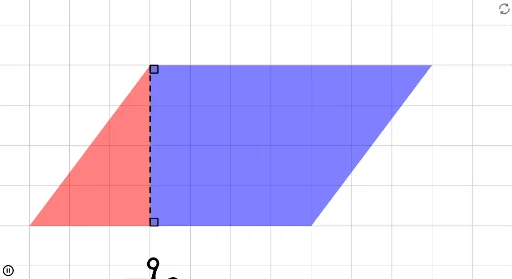
This example demonstrates the proof of the parallelogram area formula using vector translation. It involves core math concepts like vectors, translation, triangle area, and polygon division. GeoGebra commands used include Vector, Translate, Polygon, OrthogonalLine, Angle, Intersect, and Segment. Suitable for high school mathematics education to understand the geometric meaning of area calculation formulas and dynamic demonstrations.
GeoGebra Commands & Parameters
Vector(A, B) → uTranslate(C, u) → C'Polygon(A, B, C', C) → poly1, a, b, c', cOrthogonalLine(C, a) → fAngle(f, a) → αIntersect(f, a) → DPolygon(C, D, B, C') → poly2, c_1, d, b_1, c'_1Polygon(C, D, A) → poly3, a_1, c_2, d_1Translate(C, u) → C'_1Translate(D, u) → D'Translate(A, u) → A'Translate(C, Vector[((t - 2) * u)]) → C'_3Translate(D, Vector[((t - 2) * u)]) → D'_2Translate(A, Vector[((t - 2) * u)]) → A'_2Polygon(C'_3, D'_2, A'_2) → poly3'_1, a'_2, c'_3, d'_2Segment(C, M) → gSegment(C, D) → hPolygon(C', B, D') → poly4, d', c'_2, b_2Angle(C', C, D) → βAngle(C'_3, D'_2, A'_2) → δAngle(C', D', B) → γ
AI Drawing Prompt Reference
Draw a parallelogram to demonstrate the area formula proof. Start by creating vector AB, then translate point C to C'. Construct parallelogram ACBC' and its diagonals AC' and BC'. Next, construct a line perpendicular to AC' and angle α. Use intersection point D to construct triangle BCD and translate points C, D, and A to C'1, D'1, and A'1. Finally, construct parallelogram C'D'B'A' and draw auxiliary line segments CD and CM, as well as angles β and δ.
The prompt above was compiled from the original drawing commands and is for reference only.