
Demonstrating Fraction Multiplication
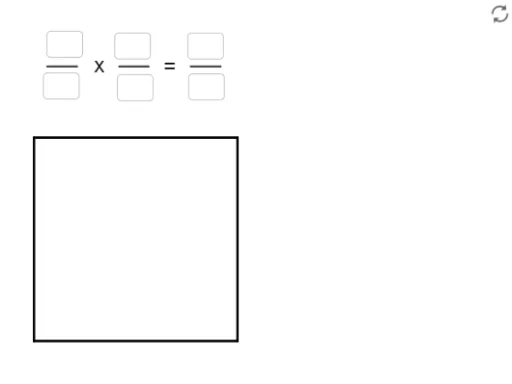
Loading the math board and drawing, please wait…
This example illustrates the geometric interpretation and calculation process of multiplying two proper fractions. It involves core math concepts like fraction multiplication, area calculation, and geometric representation. The construction utilizes GeoGebra commands such as FromBase, Intersect, Point, Polygon, Segment, Textfield, Sequence, and If to visually demonstrate the essence of fraction multiplication. Suitable for middle school mathematics education to help students understand the fundamental nature of fraction multiplication.
GeoGebra Commands & Parameters
FromBase(td_2, 10) → d_2Intersect(xAxis, yAxis) → APoint(xAxis) → A_1Polygon(A, A_1, 4) → poly1, a_1, a_2, a_3, a_4, A_2, A_3Segment(A_3, A_2) → j_tTextfield(tn_1) → InputBox1Textfield(td_1) → InputBox2Textfield(tn_2) → InputBox3Textfield(td_2) → InputBox4Textfield(tn_3) → InputBox5Textfield(td_3) → InputBox6Point(j) → E_1Point(j) → E_2Segment(E_1, E_2) → e_1Point(j) → E_3Point(j) → E_4Segment(E_3, E_4) → e_2Point(j) → E_5Point(j) → E_6Segment(E_5, E_6) → e_3FromBase(tn_1, 10) → n_1FromBase(tn_2, 10) → n_2FromBase(tn_3, 10) → n_3FromBase(td_1, 10) → d_1FromBase(td_3, 10) → d_3Segment(A, A_3) → j_lSequence((x(A), y(A) + (i * j_l / d_1)), i, 0, d_1) → plSequence((x(A_1), y(A_1) + (i * j_l / d_1)), i, 0, d_1) → prSequence(Segment[Element[pl, i], Element[pr, i]], i, 1, d_1 + 1) → list1Segment(A_2, A_1) → j_rSequence((x(A_3) + (i * j_t / d_2), y(A_3)), i, 0, d_2) → ptSequence((x(A) + (i * j_t / d_2), y(A)), i, 0, d_2) → pbSequence(Segment[Element[pt, i], Element[pb, i]], i, 1, d_2 + 1) → list2Segment(A, A_1) → j_bIntersect(Element[list2, n_2 + 1], j_b) → P_1Intersect(Element[list2, n_2 + 1], Element[list1, n_1 + 1]) → P_2Polygon(A, Element[pl, n_1 + 1], P_2, P_1) → Poly_{Sol}, P_{Sola}, P_{Solb}, P_{Solc}, P_{Sold}Sequence((x(P_1), y(P_1) + (i * j_r / d_1)), i, 0, d_1) → list3Sequence(Segment[Element[pl, i], Element[list3, i]], i, 1, d_1 + 1) → list_{sol}Polygon(A, Element[pl, n_1 + 1], Element[pr, n_1 + 1], A_1) → Poly_{First}, P_{1d}, P_{1a}, P_{1b}, P_{1c}Polygon(A, A_3, Element[pt, n_2 + 1], P_1) → Poly_{Sec}, P_{2a}, P_{2b}, P_{2c}, P_{2d}FromBase(td_4, 10) → d_4Textfield(tn_4) → InputBox3_1Textfield(td_4) → InputBox4_1FromBase(tn_4, 10) → n_4FromBase(td_5, 10) → d_5Textfield(tn_5) → InputBox1_1Textfield(td_6) → InputBox2_1Textfield(tn_6) → InputBox3_2Textfield(td_5) → InputBox4_2FromBase(tn_5, 10) → n_5FromBase(tn_6, 10) → n_6FromBase(td_6, 10) → d_6If(c ≟ 1 ∧ d ≟ 1, d ≟ 0, d ≟ 1) → e