
Demonstrating Area of Parallelograms
Loading the math board and drawing, please wait…
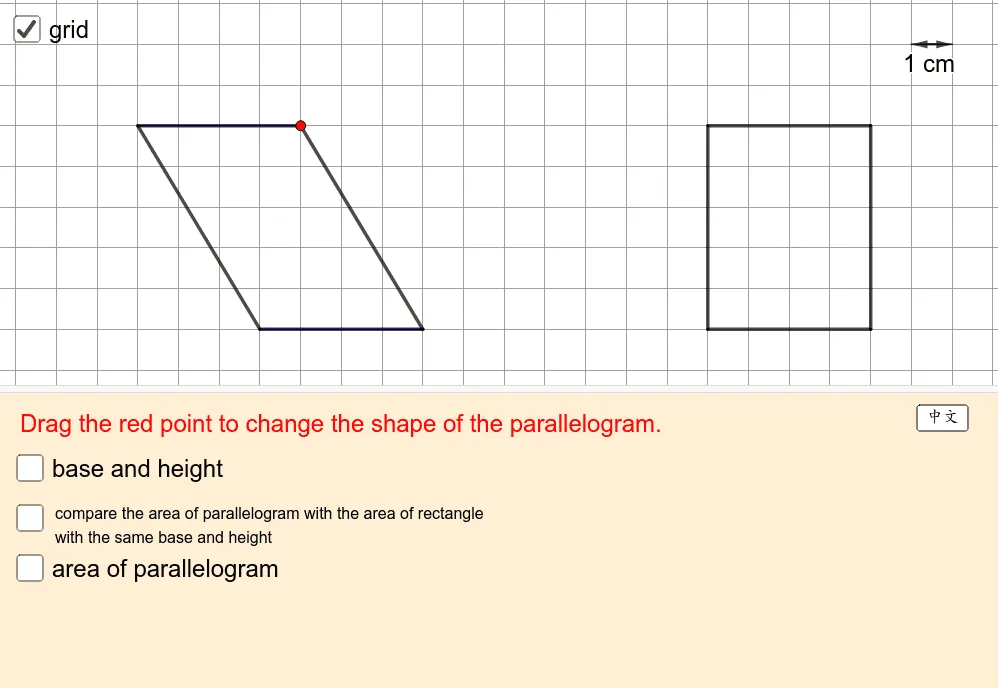
This example visually demonstrates how the area of a parallelogram is calculated by dynamically showing the relationship between base length, height, and area. Key math concepts include parallelogram properties, area formulas, vector operations, and coordinate geometry. It uses commands like Point, Intersect, Vector, Rotate, and Midpoint to create an interactive model. Suitable for middle school and high school geometry instruction, helping students grasp area derivation and geometric transformations.
GeoGebra Commands & Parameters
If(t ≥ 0 ∧ t ≤ 1, t, 1) → t1Point(xAxis) → IPoint(Ray[(0, 0), (1, 0)]) → EPoint(Ray[(-1, 0), (-2, 0)]) → CIntersect(xAxis, yAxis) → BVector(B - (0, 1), E - (0, 1)) → wPoint(Ray[(x(I), 1), (x(I), 2)]) → JRay((-0.01, y(J)), (-1, y(J))) → kPoint(k) → ATranslate(A, Vector[C]) → DIf(floor(abs(x(D)) / base) ≟ abs(x(D)) / base, false, true) → moreIf(more, n + 1, n) → n'Segment(A, B) → aSegment(B, C) → bSegment(C, D) → cSegment(D, A) → dSlope(a) → mSequence((((i + 1) * x(C)), ((m * x(C)) * i)), i, 0, n) → list1Segment(E, F) → eSegment(F, G) → fSegment(G, H) → gSegment(H, E) → hSequence(((i * x(C)), ((m * x(C)) * i)), i, 1, n) → list2Segment(J, A) → iSegment(I, B) → jRotate(J, 90°, I) → J'Vector(I, J) → uVector(J, I) → vMidpoint(I, J) → KMidpoint(b) → LAngle(J, I, Translate[I, Vector[If[x(I) > x(C), Vector[C], Vector[(-C)]]]]) → αSegment(I, J) → h_1Sequence(Polygon[Element[list1, i], Element[list2, i], Element[list2, i + 1], Element[list1, i + 1]], i, 1, n - 1) → l_{11}Vector(C - (0, 1), B - (0, 1)) → sSequence(Polygon[D, A, Element[list2, i], Element[list1, i]], i, 1, n) → l1'If(t < 1, 0, If[t ≥ 1 ∧ t ≤ 2, t - 1, 1]) → t2If(t < 2, 0, If[t ≥ 2 ∧ t ≤ 3, t - 2, 1]) → t3If(t < 3, 0, If[t ≥ 3 ∧ t ≤ 4, t - 3, 1]) → t4If(t < 4, 0, If[t ≥ 4 ∧ t ≤ 5, t - 4, 1]) → t5Union(l_{11}, l_{12}) → l1RemoveUndefined(Union[l0, l1]) → listpSequence(Translate[Element[listp, i], Vector[(If[t ≥ 0 ∧ t ≤ 1, t, 1] * w) + (If[t ≤ 1, 0, t > 1 ∧ t ≤ i, t - 1, i - 1] * s)]], i, 1, n' + If[¬more, 1, 0]) → movedlistpUnion(list1, {D}) → list1'Union(Sequence[((i * x(C)), ((m * x(C)) * i)), i, 0, n], {A}) → list2'Sequence(Segment[Element[list1', i], Element[list1', i + 1]], i, 1, n') → lists1Sequence(Translate[Element[lists1, i], Vector[(If[t ≥ 0 ∧ t ≤ 1, t, 1] * w) + (If[t ≤ 1, 0, t > 1 ∧ t ≤ i + 1, t - 1, i] * s)]], i, 1, n' + If[¬more, 1, 0]) → movedlists1Sequence(Segment[Element[list2', i], Element[list2', i + 1]], i, 1, n') → lists2Sequence(Translate[Element[lists2, i], Vector[(If[t ≥ 0 ∧ t ≤ 1, t, 1] * w) + (If[t ≤ 1, 0, t > 1 ∧ t ≤ i, t - 1, i - 1] * s)]], i, 1, n' + If[¬more, 1, 0]) → movedlists2Union(Sequence[(x(F), ((m * x(C)) * i)), i, 0, n], {G}) → list3Sequence(Segment[Element[list3, i], Element[list3, i + 1]], i, 1, n') → lists3Sequence(Translate[Element[lists3, i], Vector[(If[t ≤ i, 0, If[t ≥ i ∧ t < i + 1, t - i, 1]] * s)]], i, 1, n') → movedlists3Translate(D, Vector[(If[t < 1, t, 1] * w) + (If[t < 1, 0, t - 1] * s)]) → D'Vector(N, O) → lVector(O, N) → p