
Definition of Symmetry Rules and Geometric Construction
Loading the math board and drawing, please wait…
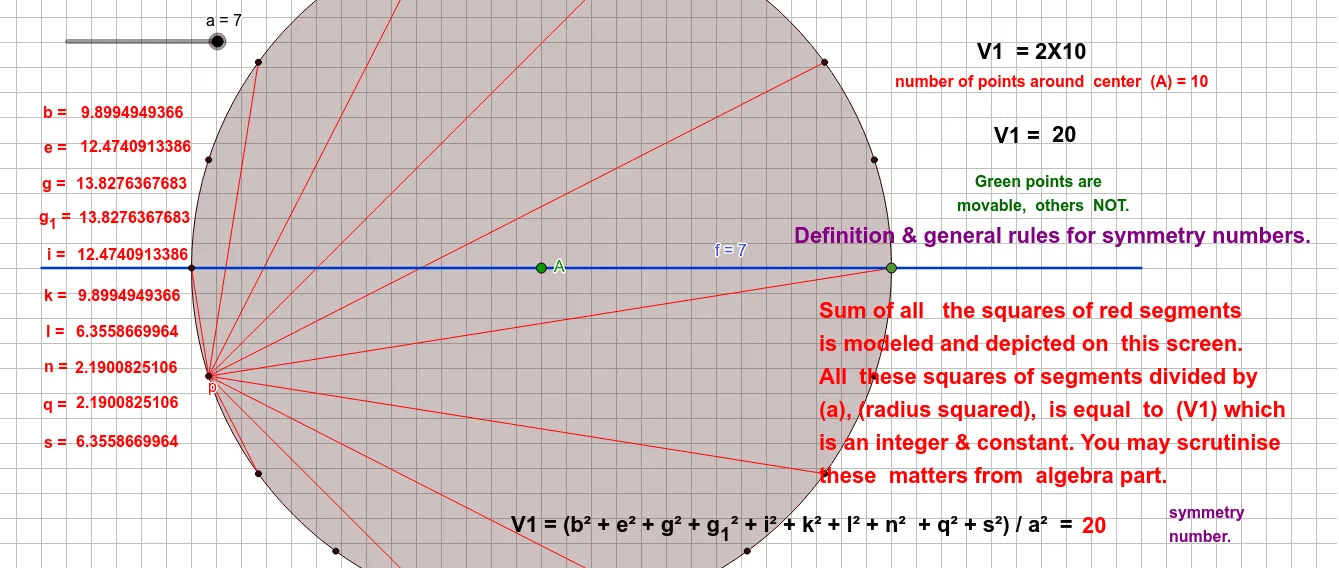
This example demonstrates the definition of symmetry rules and their application in plane geometry. The core mathematical concepts involve symmetry, geometric transformations, and the properties of circles. The construction is implemented using GeoGebra commands such as Circle, Point, Segment, and Rotate. By defining a series of primary points (A, B, C, D, etc.) and their transformed counterparts (B', B'', B''', etc.) alongside specific angle parameters (α, β, γ, etc.), the model illustrates the systematic mapping of points under symmetry. It is ideal for high school geometry students or educators exploring geometric transformations and spatial distributions.
GeoGebra Commands & Parameters
Circle(A, a) → cPoint(c) → BSegment(B, A) → fRotate(B, 18°, A) → B'Angle(B, A, B') → αRotate(B', 18°, A) → B''Angle(B', A, B'') → βRotate(B'', 18°, A) → B'''Angle(B'', A, B''') → γRotate(B''', 18°, A) → CAngle(B''', A, C) → δRotate(C, 18°, A) → C'Angle(C, A, C') → εRotate(C', 18°, A) → C''Angle(C', A, C'') → ζRotate(C'', 18°, A) → C'''Angle(C'', A, C''') → ηRotate(C''', 18°, A) → DAngle(C''', A, D) → θRotate(D, 18°, A) → D'Angle(D, A, D') → ιRotate(D', 18°, A) → D''Angle(D', A, D'') → κRotate(D'', 18°, A) → D'''Angle(D'', A, D''') → λRotate(D''', 18°, A) → EAngle(D''', A, E) → μRotate(E, 18°, A) → E'Angle(E, A, E') → νRotate(E', 18°, A) → E''Angle(E', A, E'') → ξRotate(E'', 18°, A) → E'''Angle(E'', A, E''') → οRotate(E''', 18°, A) → FAngle(E''', A, F) → ρRotate(F, 18°, A) → F'Angle(F, A, F') → σRotate(F', 18°, A) → F''Angle(F', A, F'') → τRotate(F'', 18°, A) → F'''Angle(F'', A, F''') → υSegment(B, D''') → gSegment(F'', D''') → iSegment(F, D''') → kSegment(E'', D''') → lSegment(E, D''') → nSegment(D''', D''') → pSegment(D'', D''') → qSegment(D, D''') → sSegment(C'', D''') → bSegment(C, D''') → eSegment(B'', D''') → g_1PointIn(c) → PointcSegment(I, J) → j_1