
Cylinder Unfolding by Мілочкіна Лілія
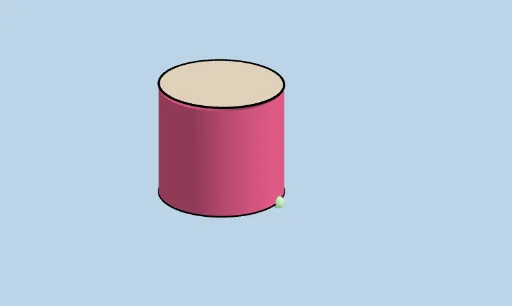
Loading the math board and drawing, please wait…
This example demonstrates the unfolding of a cylinder, visually showing how the lateral surface transforms into a rectangle. It involves core mathematical concepts such as cylinder surface area calculation, lateral unfolding, rectangle area formula, and geometric transformations. The construction utilizes GeoGebra commands and objects like Cylinder, Line, Intersect, Plane, Rotate, Dilate, Vector, Translate, Polygon, Segment, CircleArc, Angle, CurveCartesian, Surface, Midpoint, and Mirror. It is suitable for high school students learning to calculate cylinder surface areas and for solid geometry instruction.
GeoGebra Commands & Parameters
Cylinder(A, C, r) → a, c, d, bLine(D, E) → fIntersect(f, d, 1) → FSphere(F, r) → eIntersect(f, e) → G, HPlane(G, F, C) → gRotate(C, If[0 < i ≤ 1, (i * pi / 2), pi / 2], D, g) → C'Rotate(d, If[0 < i ≤ 1, (i * pi / 2), pi / 2], D, g) → d'Rotate(dd, If[0 < i ≤ 1, (i * pi / 2), pi / 2], D, g) → dd'Dilate(C, If[1 < i ≤ 2, 2 - i, 0], I) → C'_1Dilate(C, If[1 < i ≤ 2, 2 - i, 0], J) → C'_2Vector(C, C'_1) → uVector(C, C'_2) → vTranslate(dd, u) → dd'_1Translate(dd, v) → dd'_2Translate(K, u) → K'Translate(K, v) → K'_1Rotate(K', If[1 < i ≤ 2, ((i - 1) * pi), pi], C'_1) → K''Rotate(K'_1, If[1 < i ≤ 2, ((-(i - 1)) * pi), (-pi)], C'_2) → LTranslate(D, u) → D'Translate(D, v) → D'_1Polygon(D', D'_1, N, M) → poly1, d'_1, d'_2, n, mSegment(K'', Q) → jCircleArc(P, Q, M) → kSegment(L, S) → lCircleArc(R, N, S) → pCircleArc(C'_2, D'_1, L) → qCircleArc(C'_1, K'', D') → sPlane(T, A, B) → oRotate(C', If[2 < i ≤ 3, ((i - 2) * pi / 2), pi / 2], E, g) → C''Rotate(poly1, If[2 < i ≤ 3, ((i - 2) * pi / 2), pi / 2], E, g) → poly1'Rotate(d', If[2 < i ≤ 3, ((i - 2) * pi / 2), pi / 2], E, g) → d'_3Rotate(dd', If[2 < i ≤ 3, ((i - 2) * pi / 2), pi / 2], E, g) → dd'_3Rotate(K'', If[2 < i ≤ 3, ((i - 2) * pi / 2), pi / 2], E, g) → K'''Rotate(Q, If[2 < i ≤ 3, ((i - 2) * pi / 2), pi / 2], E, g) → Q'Segment(K''', Q') → j'Rotate(L, If[2 < i ≤ 3, ((i - 2) * pi / 2), pi / 2], E, g) → L'Rotate(S, If[2 < i ≤ 3, ((i - 2) * pi / 2), pi / 2], E, g) → S'Segment(L', S') → l'Dilate(C'', If[3 < i ≤ 4, 4 - i, 0], U) → C'''Vector(C'', C''') → wDilate(C'', If[3 < i ≤ 4, 4 - i, 0], V) → C'''_1Vector(C'', C'''_1) → tTranslate(Z, w) → Z'Translate(Z, t) → Z'_1Translate(W, w) → W'Translate(W, t) → W'_1Rotate(W', If[3 < i ≤ 4, ((-(i - 3)) * pi), (-pi)], C''') → W''CircleArc(C''', Z', W'') → c_1Segment(Z, Z') → f_1Rotate(W'_1, If[3 < i ≤ 4, ((i - 3) * pi), pi], C'''_1) → A_1CircleArc(C'''_1, Z'_1, A_1) → d_1Segment(Z, Z'_1) → g_1Segment(R, N) → h_1Angle(N, R, S) → αCurveCartesian(x(C'_2) + (r * cos(t)), y(C'_2) + (r * sin(t)), z(C'_2), t, pi / 2, pi / 2 + α) → a_1Vector(A, C) → ttSurface(x(C'_2) + (r * cos(t)) - (u * x(tt)), y(C'_2) + (r * sin(t)) - (u * y(tt)), z(C'_2) - (u * z(tt)), u, 0, 1, t, pi / 2, pi / 2 + α) → b_1Surface((-x(C'_2)) - (r * cos(t)) - (u * x(tt)), y(C'_2) + (r * sin(t)) - (u * y(tt)), z(C'_2) - (u * z(tt)), u, 0, 1, t, pi / 2, pi / 2 + α) → e_1Midpoint(L', S') → B_1Midpoint(K''', Q') → C_1Line(B_1, C_1) → i_1Mirror(d_1, i_1) → k_1Mirror(c_1, i_1) → p_1Mirror(Z, i_1) → Z'_2Mirror(Z', i_1) → Z''Segment(Z'_2, Z'') → j_1Mirror(Z, i_1) → Z'_3Mirror(Z'_1, i_1) → D_1Segment(Z'_3, D_1) → l_1