
Cylinder and Cone Volume Comparison by singhsaurabhi169
Loading the math board and drawing, please wait…
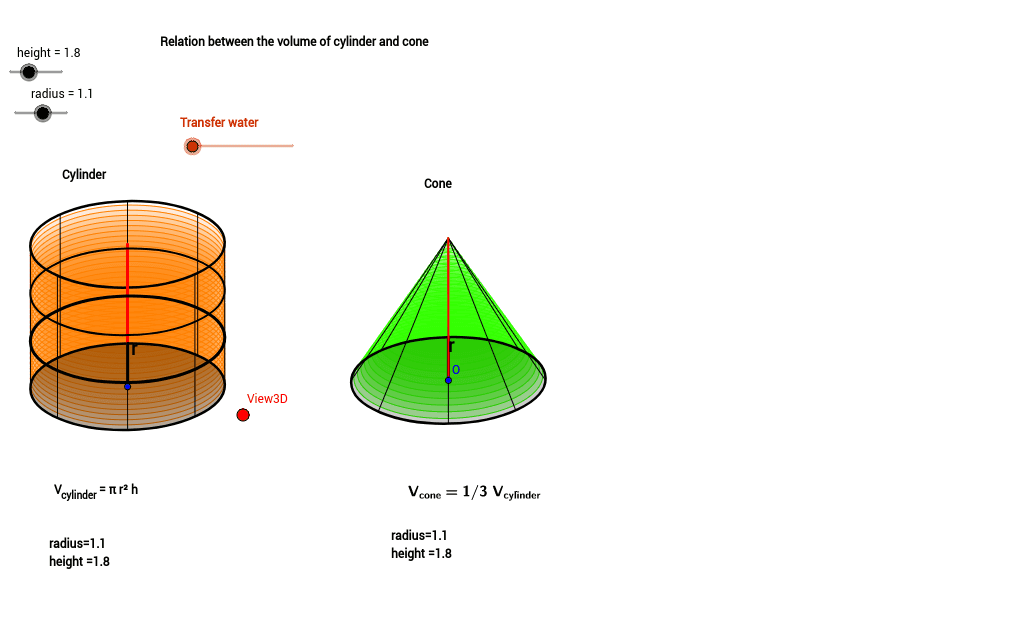
This example dynamically demonstrates the volume calculation process of cylinders and cones, visually showcasing the mathematical relationship between their volumes. Core concepts include volume formulas, geometric properties, and proportional relationships. Construction highlights the use of GeoGebra commands like Vector, Translate, OrthogonalLine, Segment, Mirror, Midpoint, Conic, Line, Intersect, Sequence, and Dilate, along with objects such as B_1, View3D, xa, sinphi, cosphi, ya, sintheta, Zoom, xy, X, a, height, O, radius, costheta, Y, v, Z, w, C, u, A_3, a_2, b_2, c, d, B, e, D, E, h_1, i, F, G, H, I, J, f, j, l. Suitable for high school students learning spatial geometry volume calculations and mathematical teaching demonstrations.
GeoGebra Commands & Parameters
Vector(B_1, Y) → vVector(B_1, X) → wTranslate(O, Vector[height * w]) → CVector(B_1, Z) → uTranslate(O, Vector[radius * u]) → A_3OrthogonalLine(View3D, yAxis) → a_2OrthogonalLine(View3D, xAxis) → b_2Segment(O, A_3) → dTranslate(O, Vector[radius * v]) → BSegment(O, B) → eMirror(B, O) → DMirror(A_3, O) → ESegment(D, O) → h_1Segment(E, O) → iMidpoint(B, A_3) → FMidpoint(B, F) → GMidpoint(O, G) → HMidpoint(H, G) → IMirror(I, G) → JConic(A_3, J, B, E, D) → fSegment(C, A_3) → jSegment(C, B) → lSegment(C, E) → m_2Segment(C, D) → n_2Line(F, O) → pMidpoint(B, E) → KLine(K, O) → qIntersect(f, p) → L, MIntersect(f, q) → N, PSegment(C, N) → rSegment(C, L) → sSegment(C, P) → tSegment(C, M) → a1Segment(C, O) → b1Vector(O, H1) → zTranslate(f, z) → p1Translate(C, z) → I1Vector(H1, I1) → u1Translate(p1, u1) → q1Translate(D, z) → J1Translate(N, z) → K1Translate(A_3, z) → M1Translate(M, z) → N1Translate(L, z) → O1Translate(E, z) → P1Translate(P, z) → Q1Translate(B, z) → R1Translate(J1, u1) → S1Translate(K1, u1) → T1Translate(M1, u1) → U1Translate(N1, u1) → V1Translate(R1, u1) → W1Translate(Q1, u1) → Z1Translate(O1, u1) → A'2Translate(P1, u1) → B2Segment(S1, J1) → l1Segment(T1, K1) → m1Segment(U1, M1) → n1Segment(V1, N1) → r1Segment(W1, R1) → s1Segment(Z1, Q1) → t1Segment(B2, P1) → a2Segment(A'2, O1) → b2Segment(I1, H1) → g2Segment(H1, M1) → h2Sequence(Translate[p1, Vector[i * u1]], i, 0, 1, o) → L1Sequence(Dilate[f, i, C], i, 0, 1, o) → L2Midpoint(h2) → J_1Midpoint(d) → L_1Dilate(f, a, C) → f'_2Translate(p1, Vector[a / 3 * u1]) → p1'Translate(p1, Vector[1 / 3 * u1]) → p1'_1Translate(p1, Vector[2 / 3 * u1]) → p1'_2Sequence(Dilate[f, i, C], i, a, 1, o) → liste11Sequence(Translate[p1, Vector[i * u1]], i, 0, a / 3, o) → liste1