
Cyclic Quadrilateral
Loading the math board and drawing, please wait…
In collections
CLASS IX CBSE MATHS ACTIVITIES
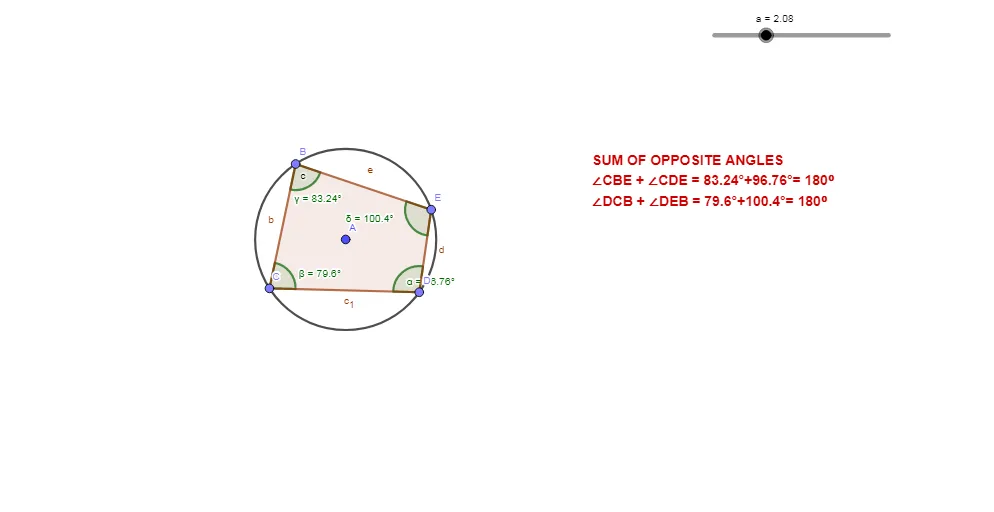
This example demonstrates the geometric properties and construction of a cyclic quadrilateral. It involves core math concepts like circle, polygon, angle, and geometric construction. Key GeoGebra commands used include Circle, Point, Polygon, and Angle to draw and measure angles in a cyclic quadrilateral. Suitable for high school mathematics education to understand symmetry and angle relationships in cyclic quadrilaterals, fostering geometric intuition and construction skills.
GeoGebra Commands & Parameters
Circle(A, a) → cPoint(c) → BPoint(c) → CPoint(c) → DPoint(c) → EPolygon(B, C, D, E) → q1, b, c_1, d, eAngle(E, D, C) → αAngle(D, C, B) → βAngle(C, B, E) → γAngle(B, E, D) → δ
AI Drawing Prompt Reference
Draw a circle and place four arbitrary points on its circumference. Connect these four points in order to form a quadrilateral. Then mark and measure the four interior angles at each vertex, showing the angles between adjacent sides. This figure illustrates a cyclic quadrilateral with all vertices on the circle, demonstrating that opposite angles are supplementary and the sum of interior angles is 360 degrees. Focus on the circle, the inscribed quadrilateral, and the labeled angles to highlight geometric construction and angle relationships.
The prompt above was compiled from the original drawing commands and is for reference only.