
Cyclic Quadrilateral Properties Demo by Tim Brzezinski
Loading the math board and drawing, please wait…
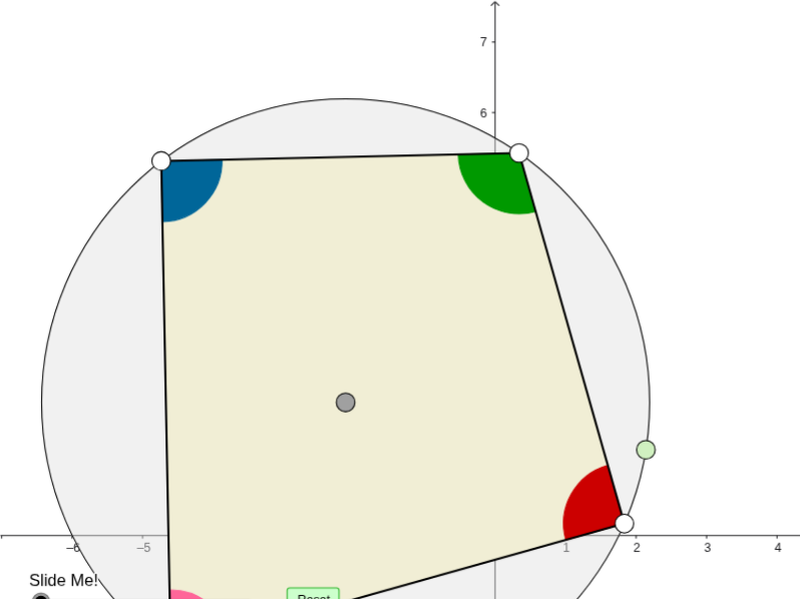
This example demonstrates the properties of a cyclic quadrilateral, focusing on the immediate consequence of the inscribed angle theorem: opposite angles sum to 180 degrees. It involves core concepts like inscribed angles, central angles, and the properties of cyclic quadrilaterals. Construction uses commands such as Circle, Point, Segment, Intersect, and Polygon. Suitable for middle school and high school students to explore geometric properties and applications of the inscribed angle theorem.
GeoGebra Commands & Parameters
Circle(A, B) → cPoint(c) → CRotate(C, 2°, A) → C'CircleArc(A, C', C) → dPoint(d) → DCircleArc(A, D, C) → ePoint(e) → ECircleArc(A, E, C) → fPoint(f) → FCircleArc(A, F, C) → gPoint(g) → GSegment(D, E) → bSegment(E, F) → hSegment(D, G) → aSegment(G, F) → iCircle(F, (0.2 * Distance[A, B])) → kCircle(E, (0.2 * Distance[A, B])) → pCircle(G, (0.2 * Distance[A, B])) → qCircle(D, (0.2 * Distance[A, B])) → rIntersect(k, i, 1) → HIntersect(k, h, 1) → IIntersect(p, h, 1) → JIntersect(p, b, 1) → KIntersect(r, a, 1) → LIntersect(r, b, 1) → MIntersect(q, a, 1) → NIntersect(q, i, 1) → OCircleSector(G, N, O) → sCircleSector(F, H, I) → tCircleSector(E, J, K) → c_1CircleSector(D, M, L) → d_1Circle(A, B) → e_1Dilate(E, If[0 < j ≤ 1, 1 - j, 0], G) → E'Vector(E, E') → uTranslate(c_1, u) → f_1CircleArc(E, J, K) → g_1Translate(J, u) → J'Angle(O, G, J') → αRotate(f_1, If[1 < j ≤ 2, ((-(j - 1)) * α), (-α)], G) → h_1Ray(D, G) → lPoint(l) → PRay(G, P) → mDilate(F, If[2 < j ≤ 3, 3 - j, 0], D) → F'Vector(F, F') → vRay(G, D) → nPoint(n) → QRay(D, Q) → a_1Translate(t, v) → t'CircleArc(F, H, I) → k_1Translate(I, v) → I'Angle(I', D, M) → βRotate(t', If[3 < j ≤ 4, ((j - 3) * β), β], D) → t''Polygon(G, D, E, F) → poly1, g_2, d_2, e_2, f_2
AI Drawing Prompt Reference
Draw a circle with several points on its circumference. Connect consecutive points to form a quadrilateral whose vertices all lie on the circle. At each vertex, place a small circle marker and draw a sector between the two adjacent sides, filling each sector with a different color. Additionally, pick a point on one side of the quadrilateral, draw a ray from that point toward the opposite side, and place another point on the ray. Then translate and rotate one of the vertex sectors along the ray to demonstrate that opposite angles of the cyclic quadrilateral sum to 180 degrees.
The prompt above was compiled from the original drawing commands and is for reference only.