
Cyclic Quadrilateral: Proof Hint
Loading the math board and drawing, please wait…
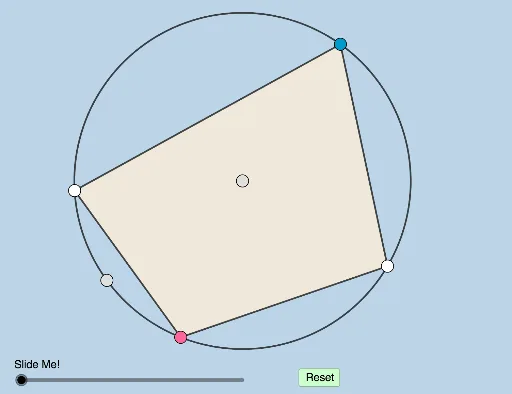
This example demonstrates the proof hint for a cyclic quadrilateral, involving the corollary of the inscribed angle theorem. It is dynamic and modifiable, allowing observation of the properties of cyclic quadrilaterals. Mainly using Circle, Point, Polygon, Segment, Angle, Rotate commands in GeoGebra. Suitable for students at junior high school level and above for geometry proof learning.
GeoGebra Commands & Parameters
Circle(A, B) → cPoint(c) → CPoint(c) → DCircleArc(A, C, D) → dCircleArc(A, D, C) → ePoint(e) → ECircleArc(A, D, E) → fCircleArc(A, E, C) → gPoint(g) → FPolygon(F, C, D, E) → q1, f_1, c_1, d_1, e_1Segment(C, D) → hSegment(D, E) → iSegment(E, F) → jRay(F, C) → kMin({i, j, h, Distance[F, C]}) → aCircle(E, (0.2 * a)) → pIntersect(p, j) → G,Angle(F, E, D) → αRotate(G, If[0 < b ≤ 1, (b * α), α], E) → G'CircleSector(E, G, G') → qDilate(E, If[1.5 < b ≤ 2.5, 2.5 - b, 0], C) → E'Vector(E, E') → uTranslate(q, u) → q'Line(E, k) → lPoint(l) → HAngle(G, E, H) → βCircle(C, (0.2 * a)) → rIntersect(r, h, 1) → IRotate(I, If[0 < b ≤ 1, (b * (π - α)), π - α], C) → I'CircleSector(C, I, I') → sDilate(A, If[1 < b ≤ 2, 2 - b, 0], D) → A'Dilate(A, If[1 < b ≤ 2, 2 - b, 0], F) → A'_1Segment(A, A') → mSegment(A, A'_1) → nLine(A, i) → tAngle(F, A, D) → γRotate(F, γ / 2, A) → F'Angle(F, A, F') → δDilate(E, If[2 < b ≤ 3, 3 - b, 0], A) → E'_1Vector(E, E'_1) → vTranslate(q, v) → q'_1Point(t) → JAngle(J, A, D) → εRotate(q'_1, If[2 < b ≤ 3, ((b - 2) * ε), ε], E'_1) → g_1Dilate(C, If[3 < b ≤ 4, 4 - b, 0], A) → C'Vector(C, C') → wTranslate(s, w) → s'Line(A, h) → h_1Point(h_1) → KAngle(D, A, K) → ζRotate(s', If[3 < b ≤ 4, ((b - 3) * ((2 * π) - ζ)), (2 * π) - ζ], C') → s''Dilate(A, If[4 < b ≤ 5, 5 - b, 0], F') → A'_2Rotate(D, π - γ / 2, A) → D'Dilate(A, If[4 < b ≤ 5, 5 - b, 0], D') → A'_3Segment(A, A'_2) → i_1Segment(A, A'_3) → j_1Rotate(I, If[4 < b ≤ 5, ((b - 4) * (π - α)), π - α], C) → I'_1Rotate(G, If[4 < b ≤ 5, ((b - 4) * α), α], E) → G'_1CircleSector(C, I, I'_1) → k_1CircleSector(E, G, G'_1) → p_1Dilate(E, If[5.5 < b ≤ 6.5, 6.5 - b, 0], A) → E'_2Vector(E, E'_2) → u_1Translate(p_1, u_1) → q_1Line(A, j) → l_1Point(l_1) → LAngle(F, A, L) → ηRotate(q_1, If[5.5 < b ≤ 6.5, ((b - 5.5) * ((2 * π) - η)), (2 * π) - η], E'_2) → r_1CircleArc(A, F, D) → s_1CircleArc(A, D, F) → t_1CircleArc(A, F, D) → c_2Dilate(C, If[6.5 < b ≤ 7.5, 7.5 - b, 0], A) → C'_1Vector(C, C'_1) → v_1Translate(k_1, v_1) → d_2Line(A, k) → m_1Point(m_1) → MAngle(M, A, F) → θRotate(d_2, If[6.5 < b ≤ 7.5, ((b - 6.5) * θ), θ], C'_1) → e_2CircleArc(A, D, F) → f_2Segment(F, C) → n_1
AI Drawing Prompt Reference
Draw a circle and select two points on it. Use these points as centers to draw two tangent circles. The intersection points form a quadrilateral. Label the interior angles and demonstrate the sum of interior angles theorem. Add a slider to dynamically adjust the figure and observe the angle changes.
The prompt above was compiled from the original drawing commands and is for reference only.