
Explore Cyclic Polygons: Dynamic Geometry of Inscribed Shapes
Loading the math board and drawing, please wait…
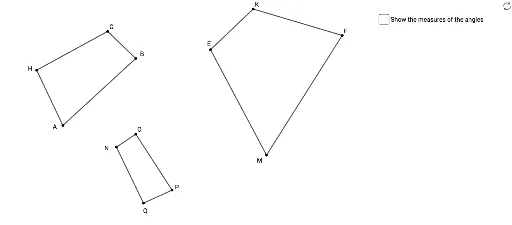
This interactive GeoGebra construction invites learners to explore cyclic polygons—polygons whose vertices all lie on a common circle. By dragging points on the circle, users observe how side lengths, interior angles, and the total perimeter change, revealing key relationships such as the constant sum of interior angles and the emergence of isosceles triangles from radii. The core mathematical concepts include circle geometry, polygon angle sums, the arithmetic mean of side lengths, and the limiting behavior as the number of sides increases toward a circle. The construction is built using Circle, Point, Polygon, and Angle commands, with objects including vertices A_1, B, C, D, E, F, G, H, and measured angles α, β, γ, δ, ε. It is ideal for middle school through undergraduate geometry courses, enabling hands-on experimentation with random vertex placement and slider-based animation to visualize how perimeter relates to the number of sides and the circle's radius. This resource supports inquiry-based learning and helps students grasp fundamental concepts of cyclic polygons and their approximation to circles.
GeoGebra Commands & Parameters
Circle(A_1, B) → cCircle(C, D) → dCircle(E_1, F_1) → ePoint(c) → GPoint(c) → HPoint(c) → APolygon(B, G, H, A) → q1, b, g, h, iPoint(d) → EPoint(d) → KPoint(d) → FPoint(d) → MPolygon(E, K, F, M) → q2, j, k, l, mPoint(e) → NPoint(e) → OPoint(e) → PPoint(e) → QPolygon(N, O, P, Q) → q3, n, o, p, qAngle(B, A, H) → αAngle(A, H, G) → βAngle(G, B, A) → γAngle(H, G, B) → δAngle(K, F, M) → εAngle(F, M, E) → ζAngle(M, E, K) → ηAngle(E, K, F) → θAngle(N, O, P) → ιAngle(O, P, Q) → κAngle(P, Q, N) → λAngle(Q, N, O) → μ
AI Drawing Prompt Reference
Draw three circles of different sizes. On each circle, place four points and connect them to form a quadrilateral whose vertices all lie on the circle. Use distinct colors or line styles for each quadrilateral. Inside each quadrilateral, mark all interior angles with arcs and display their degree measures. All points should be draggable, so that when moved, the quadrilateral changes shape but its vertices remain on the circle. This illustrates the dynamic geometry of cyclic quadrilaterals, showing how side lengths, angles, and perimeter vary with vertex positions.
The prompt above was compiled from the original drawing commands and is for reference only.