
Cutting the Cube with an Interactive Plane: Cross-Sections and Polyhedra
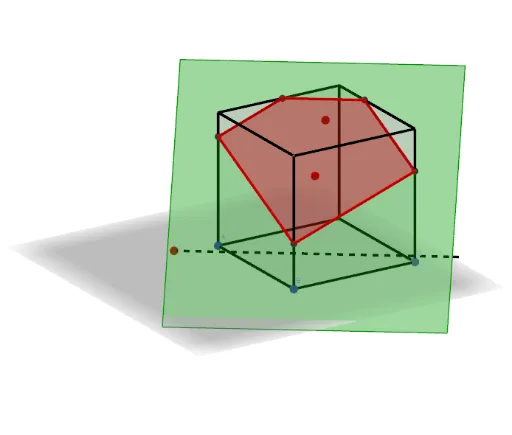
Loading the math board and drawing, please wait…
This example demonstrates how an interactive movable plane cuts a cube, generating real-time cross-section polygons and revealing the resulting polyhedral parts. Core mathematical concepts include solid geometry of plane-polyhedron intersections, how the cross-section shape changes with plane orientation, and combinatorial counting of vertices, edges, and faces. Construction highlights: using GeoGebra commands such as Point, Cube, Midpoint, Line, Circle, Mirror, Plane, Center, OrthogonalLine, Vector, Translate, Segment, Intersect, Polygon, and IntersectPath to build the cube and its six faces, then compute intersection points with edges to form the section polygon. Suitable for high school or early college students for intuitive teaching of solid geometry, exploring cross-section properties, and enhancing spatial reasoning.
GeoGebra Commands & Parameters
Point(Circle[B, Distance[A, B], Segment[A, B]]) → CCube(A, B, C) → a, D, faceCDHG, faceEFGH, arêteAD, arêteAB, arêteBC, arêteCD, arêteAE, arêteDH, arêteEH, arêteEF, E, arêteBF, arêteFG, arêteCG, arêteGH, F, G, H, faceABCD, faceADHE, faceABFE, faceBCGFMidpoint(C, A) → IMidpoint(F, H) → JLine(J, I) → fCircle(I, Distance[A, B], f) → cPoint(c) → KMidpoint(F, C) → MMirror(K, I) → K'Line(K', K) → gCircle(I, (1.2 * Distance[A, B]), g) → dPoint(d) → LPlane(L, K, K') → pCircle(K', L, K) → eCenter(e) → NOrthogonalLine(N, p) → hPoint(h) → OVector(N, O) → uTranslate(p, u) → p'Segment(K', K) → bLine(L, b) → f_1Point(arêteEF) → D_1OrthogonalLine(K, p) → h_1Plane(K', h_1) → p_1OrthogonalLine(K, p_1) → k_1Line(K', k_1) → l_1Intersect(f_1, l_1) → E_1Intersect(k_1, f_1) → F_1Mirror(F_1, K) → G_1Mirror(E_1, K') → H_1Polygon(F_1, E_1, H_1, G_1) → q2, m_1, e_1, n_1, q_1Translate(q2, u) → q2'IntersectPath(p', a) → poly1, P, l, t, m, Q, R, S, A_1, T, i, j, k
AI Drawing Prompt Reference
Draw an interactive plane cutting a cube to show real-time cross-section polygons and resulting polyhedral parts. The cube has six faces, and the plane intersects it as its position is adjusted, changing the cross-section shape. Calculate intersection points between the section polygon and cube edges, displaying the combination of vertices, edges, and faces, suitable for teaching solid geometry and spatial reasoning.
The prompt above was compiled from the original drawing commands and is for reference only.