
Curved Surface Area of Cones by Mark Willis
Loading the math board and drawing, please wait…
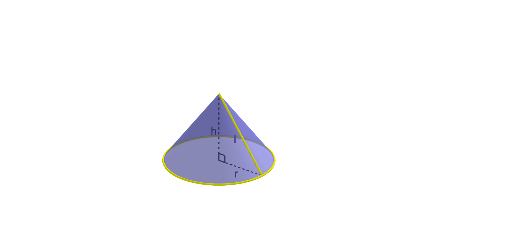
This example demonstrates how the curved surface of a cone can be flattened into a sector, which is then dissected and rearranged to show that its area equals πrl. Key math concepts include surface area, sector area, and cone geometry. GeoGebra commands like Point, If, Sequence, CircleArc, Segment, Midpoint, Circle, Intersect, Rotate, Surface, CircumcircleArc, Vector, and Angle are used in the construction. Suitable for high school students learning about cone surface area formulas and spatial geometric transformations.
GeoGebra Commands & Parameters
Point(CircleArc[(0, 1), (1, 1), (0, 0)]) → QIf(y(Q) > 0, CircleArc[(0, 1), (0, 0), Q], 6.283185307179586) → sIf(y(Q) > 0, Angle[(0, 0), (0, 1), Q], 6.283185307179586) → α'Sequence((sin((i * θ)), 1 - cos((i * θ))), i, 0, (2 * n)) → list1If(t ≤ 1, t, 1) → kIf(t ≥ 1, t - 1, 0) → k'Sequence(If[k < 1, (x(O_1) + ((l * sin((i * φ))) * cos((i * φ)) / sin(φ)), y(O_1) + ((l * sin((i * φ))) * sin((i * φ)) / sin(φ))), (x(O_1) + (l * i), y(O_1))], i, 0, (2 * n)) → list2Sequence(Sector[Rotate[Translate[Circle[(x(O_1) + 0, y(O_1) + 1), Element[list1, i]], Vector[Element[list1, i], Element[list2, i]]], (((-((2 * i) - 1)) * k) * θ / 2), Element[list2, i]], Rotate[Translate[Element[list1, i], Vector[Element[list1, i], Element[list2, i]]], (((-((2 * i) - 1)) * k) * θ / 2), Element[list2, i]], Rotate[Translate[Element[list1, i + 1], Vector[Element[list1, i], Element[list2, i]]], (((-((2 * i) - 1)) * k) * θ / 2), Element[list2, i]]], i, 1, n) → list3Sequence(Sector[Rotate[Rotate[Translate[Circle[(x(O_1) + 0, y(O_1) + 1), Element[list1, i]], Vector[Element[list1, i], Element[list2, i]]], (((-((2 * i) - 1)) * k) * θ / 2), Element[list2, i]], (180° * k'), (x(O_1) + (n * l) - sin(θ / 2) / 2, y(O_1) + cos(θ / 2) / 2)], Rotate[Rotate[Translate[Element[list1, i], Vector[Element[list1, i], Element[list2, i]]], (((-((2 * i) - 1)) * k) * θ / 2), Element[list2, i]], (180° * k'), (x(O_1) + (n * l) - sin(θ / 2) / 2, y(O_1) + cos(θ / 2) / 2)], Rotate[Rotate[Translate[Element[list1, i + 1], Vector[Element[list1, i], Element[list2, i]]], (((-((2 * i) - 1)) * k) * θ / 2), Element[list2, i]], (180° * k'), (x(O_1) + (n * l) - sin(θ / 2) / 2, y(O_1) + cos(θ / 2) / 2)]], i, n + 1, (2 * n)) → list4CircleArc((0, 1 / (1 - m)), O_1, L) → bSegment((0, 0), (s, 0)) → dMidpoint(d) → B'CircleArc((0, 1), Q, (0, 0)) → cSegment(O, (x(O), y(O) - 1)) → eMidpoint(e) → GCircle((0, 1), 1) → gMidpoint(Q, O) → HSegment(O, A) → aCircle(P, 1, yAxis) → pIntersect(xOyPlane, p) → D, CRotate(O_1, α, a) → FSurface((u * cos(v)), (u * sin(v)) + 1, f(u), u, 0, abs(x(D)), v, -1.5708, (3 * π / 2) - (2 * γ)) → oRotate(D_1, α, a) → D'CircumcircleArc(D_1, C, D') → qCircle(O, D_1, a) → c_1Segment(P, D') → iSegment(P, D_1) → a_1Point(b) → JSegment(O, D_1) → b_1Vector(A + (0, 0, 0.3), A + (0, 0, 0.06)) → uAngle(D_1, O, A) → β