
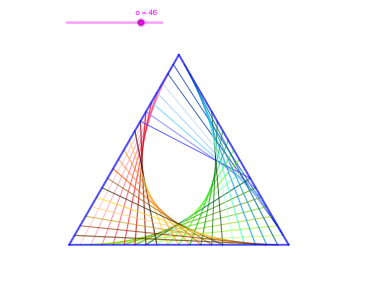
Curve Stitching the Trefoil Knot
Loading the math board and drawing, please wait…
This example demonstrates how to stitch curves into a trefoil knot using geometric constructions. It involves concepts like locus, circle properties, and geometric transformations. The construction uses GeoGebra commands such as Polygon, Circle, Intersect, and LineBisector to create shapes and intersections. Suitable for high school students or college students learning geometry and curve properties.
GeoGebra Commands & Parameters
Polygon(A, B, 3) → poly1, f, g, h, CDistance(A, B) → dSegment(A, C) → iCircle(A, t) → cCircle(A, (t * 2)) → eCircle(A, (t * 3)) → kCircle(A, (t * 4)) → pCircle(A, (t * 5)) → qCircle(A, (t * 6)) → rCircle(A, (t * 7)) → sCircle(A, (t * 8)) → c_1Circle(A, (t * 9)) → d_1Circle(A, (t * 10)) → e_1Circle(A, (t * 11)) → f_1Circle(A, (t * 12)) → g_1Circle(A, (t * 13)) → h_1Circle(A, (t * 14)) → k_1Circle(A, (t * 15)) → p_1Circle(A, (t * 16)) → q_1Circle(A, (t * 17)) → r_1Circle(A, (t * 18)) → s_1Circle(A, (t * 19)) → t_1Circle(A, (t * 20)) → c_2Intersect(c, i, 1) → DIntersect(e, i, 1) → EIntersect(k, i, 1) → FIntersect(p, i, 1) → GIntersect(q, i, 1) → HIntersect(r, i, 1) → IIntersect(s, i, 1) → JIntersect(c_1, i, 1) → KIntersect(d_1, i, 1) → LIntersect(e_1, i, 1) → MIntersect(f_1, i, 1) → NIntersect(g_1, i, 1) → OIntersect(h_1, i, 1) → PIntersect(k_1, i, 1) → QIntersect(p_1, i, 1) → RIntersect(q_1, i, 1) → SIntersect(r_1, i, 1) → TIntersect(s_1, i, 1) → UIntersect(t_1, i, 1) → VLineBisector(g) → jMirror(V, j) → V'Mirror(U, j) → U'Mirror(T, j) → T'Mirror(S, j) → S'Mirror(R, j) → R'Mirror(Q, j) → Q'Mirror(P, j) → P'Mirror(O, j) → O'Mirror(N, j) → N'Mirror(M, j) → M'Mirror(L, j) → L'Mirror(K, j) → K'Mirror(J, j) → J'Mirror(I, j) → I'Mirror(H, j) → H'Mirror(G, j) → G'Mirror(F, j) → F'Mirror(E, j) → E'Mirror(D, j) → D'LineBisector(A, B) → lMirror(V, l) → V'_{1}Mirror(U, l) → U'_{1}Mirror(T, l) → T'_{1}Mirror(S, l) → S'_{1}Mirror(R, l) → R'_{1}Mirror(Q, l) → Q'_{1}Mirror(P, l) → P'_{1}Mirror(O, l) → O'_{1}Mirror(O, l) → O'_{2}Mirror(N, l) → N'_{1}Mirror(L, l) → L'_{1}Mirror(M, l) → M'_{1}Mirror(K, l) → K'_{1}Mirror(J, l) → J'_{1}Mirror(I, l) → I'_{1}Mirror(H, l) → H'_{1}Mirror(G, l) → G'_{1}Mirror(F, l) → F'_{1}Mirror(E, l) → E'_{1}Mirror(D, l) → D'_{1}Segment(V, D') → mSegment(D', D'_{1}) → nSegment(D'_{1}, V) → aSegment(U, E') → bSegment(E', E'_{1}) → i_1Segment(E'_{1}, U) → j_1Segment(T, F') → l_1Segment(F', F'_{1}) → m_1Segment(F'_{1}, T) → n_1Segment(S, G') → a_1Segment(G', G'_{1}) → b_1Segment(G'_{1}, S) → f_2Segment(R, H') → g_2Segment(H', H'_{1}) → h_2Segment(H'_{1}, R) → i_2Segment(Q, I') → j_2Segment(I', I'_{1}) → k_2Segment(I'_{1}, Q) → l_2Segment(P, J') → m_2Segment(J', J'_{1}) → n_2Segment(J'_{1}, P) → p_2Segment(O, K') → q_2Segment(K', K'_{1}) → r_2Segment(K'_{1}, O) → s_2Segment(N, L') → t_2Segment(L', L'_{1}) → a_2Segment(L'_{1}, N) → b_2Segment(M, M') → d_2Segment(M', M'_{1}) → e_2Segment(M'_{1}, M) → f_3Segment(L, N') → g_3Segment(N', N'_{1}) → h_3Segment(L, N'_{1}) → i_3Segment(K, O') → j_3Segment(O', O'_{1}) → k_3Segment(O'_{1}, K) → l_3Segment(J, P') → m_3Segment(P', P'_{1}) → n_3Segment(P'_{1}, J) → p_3Segment(I, Q') → q_3Segment(Q', Q'_{1}) → r_3Segment(Q'_{1}, I) → s_3Segment(H, R') → t_3Segment(R', R'_{1}) → a_3Segment(R'_{1}, H) → b_3Segment(G, S') → c_3Segment(S', S'_{1}) → d_3Segment(S'_{1}, G) → e_3Segment(F, T') → f_4Segment(T', T'_{1}) → g_4Segment(T'_{1}, F) → h_4Segment(E, U') → i_4Segment(U', U'_{1}) → j_4Segment(U'_{1}, E) → k_4Segment(D, V') → l_4Segment(V', V'_{1}) → m_4Segment(D, V'_{1}) → n_4Segment(C, A) → p_4Segment(A, B) → q_4Segment(B, C) → r_4
AI Drawing Prompt Reference
Draw a trefoil knot formed by stitching curves. The figure should include a polygon and multiple circles that intersect with the polygon to create intersection points. Then reflect these points symmetrically using mirror operations. The overall construction should reflect geometric principles, showing how curves connect to form the knot shape.
The prompt above was compiled from the original drawing commands and is for reference only.