
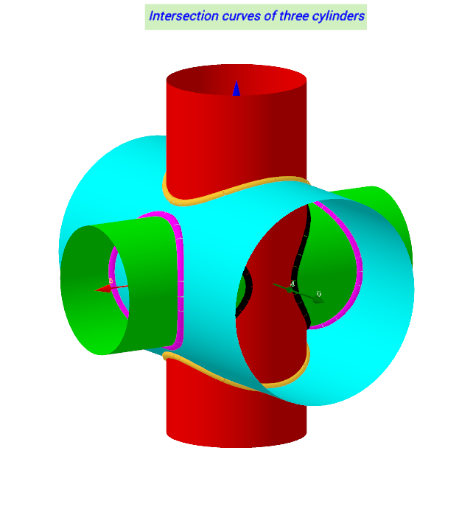
Curve of Intersection of 3 Cylinder Surfaces
Loading the math board and drawing, please wait…
In collections
intersection: surface-surface, curve-curve
intersection: surface-surface, curve-curve
intersection: surface-surface, curve-curve
intersection: surface-surface, curve-curve
This example demonstrates the spatial curve formed by the intersection of three cylindrical surfaces. Key math concepts include analytical geometry, solid geometry, functions, and parametric equations. The construction utilizes GeoGebra commands Max, Sequence, and LaTeX, along with objects like r3, r2, r1, text4, d, zyl1, max_1, max, e, f, g, zyl2, l_{12}, zyl3, l_{13}, l_{23}, text3, text6, text7, text8, text1, text2. Suitable for high school and above students studying spatial geometry and parametric equations.
GeoGebra Commands & Parameters
Max({r1, r2, r3}) → max_1Sequence(Sequence[CurveCartesian[t, (i * sqrt(r1^(2) - t^(2))), (j * sqrt(r2^(2) - t^(2))), t, (-max), max], j, -1, 1, 2], i, -1, 1, 2) → l_{12}Sequence(Sequence[CurveCartesian[t, (i * sqrt(r1^(2) - t^(2))), (j * sqrt(t^(2) + r3^(2) - r1^(2))), t, (-max), max], j, -1, 1, 2], i, -1, 1, 2) → l_{13}Sequence(Sequence[CurveCartesian[t, (i * sqrt(t^(2) + r3^(2) - r2^(2))), (j * sqrt(r2^(2) - t^(2))), t, (-max), max], j, -1, 1, 2], i, -1, 1, 2) → l_{23}LaTeX(zyl1, false, false) → text3LaTeX(zyl3, false, false) → text6LaTeX(zyl2, false, false) → text7