
Curry Paradox: Area Illusion in Geometry and Algebra
Loading the math board and drawing, please wait…
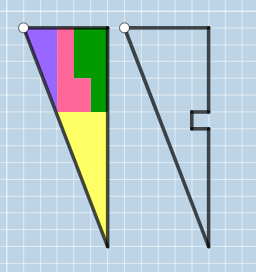
The Curry Paradox demonstrates a seemingly reasonable geometric figure area calculation that yields an unexpected result. This phenomenon involves geometry, algebra, and real numbers, using GeoGebra commands to create triangles, line segments, and coordinate points. Adjusting parameters allows observation of area changes. Suitable for high school students or math enthusiasts to understand the relationship between geometry and algebra, and deepen understanding of area concepts.
GeoGebra Commands & Parameters
Polygon(A, B, C) → t1, c, a, bPolygon(D, E, F, I, H, G) → poly1, d, e, f, i, h, gPolygon(J, K, L, M, N, O) → poly2, j, k, l, m, n, oPolygon(P, Q, R) → t2, r, p, qPolygon(S, T, V, W, Z, A_1, U, E_1) → poly3, s, t, q_1, r_1, s_1, t_1, a_1, b_1Segment(S, T) → f_1Segment(T, V) → g_1Segment(V, W) → h_1Segment(W, Z) → i_1Segment(Z, A_1) → j_1Segment(A_1, U) → k_1Segment(U, S) → l_1Segment(B_1, C_1) → m_1Segment(C_1, D_1) → n_1Segment(D_1, B_1) → p_1
AI Drawing Prompt Reference
Draw a Curry Paradox figure composed of six triangles, including two large triangles t1 and t2, and three smaller triangles poly1, poly2, and poly3. Start by drawing t1 and t2, then sequentially draw poly1, poly2, and poly3, and finally connect the sides of the triangles to form a closed shape.
The prompt above was compiled from the original drawing commands and is for reference only.