
Cuboid Geometric Construction
Loading the math board and drawing, please wait…
In collections
Hands in the Air: Square Translation Tessellation
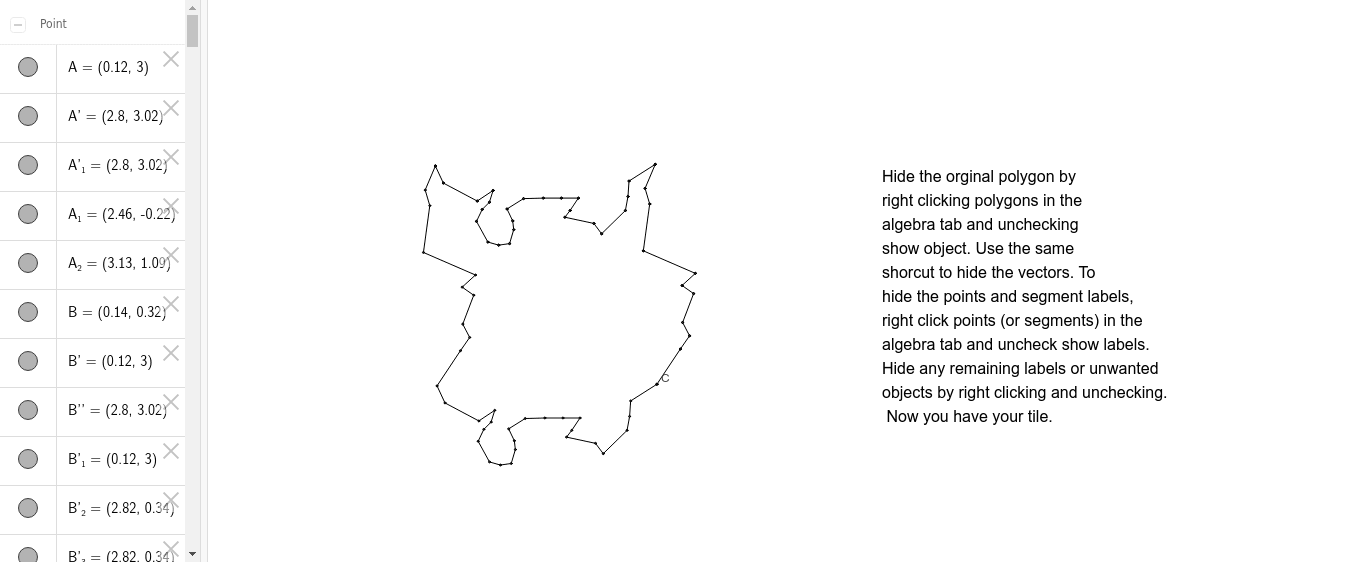
This example demonstrates how to use GeoGebra to draw a cuboid. It involves logarithms, arithmetic mean, conic sections, subtraction, and cuboid geometric construction. By using commands like Polygon, Segment, Vector, Translate, etc., the faces and edges of the cuboid can be constructed. Suitable for middle school and above students or teachers.
GeoGebra Commands & Parameters
Polygon(A, B, 4) → poly1, a, b, c, d, C, DSegment(B, E) → eSegment(E, F) → fSegment(F, G) → gSegment(G, H) → hSegment(H, I) → iSegment(I, J) → jSegment(J, K) → kSegment(K, L) → lSegment(L, M) → mSegment(M, N) → nSegment(N, O) → pSegment(O, P) → qSegment(P, Q) → rSegment(Q, R) → sSegment(R, S) → tSegment(S, T) → a_1Segment(T, U) → b_1Segment(U, V) → c_1Segment(V, W) → d_1Segment(W, Z) → e_1Segment(Z, A_1) → f_1Segment(A_1, B_1) → g_1Segment(B_1, C_1) → h_1Segment(C_1, C) → i_1Vector(B, A) → uTranslate(B, u) → B'Translate(C, u) → C'Segment(B', C') → b'Translate(B, u) → B'_1Translate(E, u) → E'Segment(B'_1, E') → e'Translate(E, u) → E'_1Translate(F, u) → F'Segment(E'_1, F') → f'Translate(F, u) → F'_1Translate(G, u) → G'Segment(F'_1, G') → g'Translate(G, u) → G'_1Translate(H, u) → H'Segment(G'_1, H') → h'Translate(H, u) → H'_1Translate(I, u) → I'Segment(H'_1, I') → i'Translate(I, u) → I'_1Translate(J, u) → J'Segment(I'_1, J') → j'Translate(J, u) → J'_1Translate(K, u) → K'Segment(J'_1, K') → k'Translate(K, u) → K'_1Translate(L, u) → L'Segment(K'_1, L') → l'Translate(L, u) → L'_1Translate(M, u) → M'Segment(L'_1, M') → m'Translate(M, u) → M'_1Translate(N, u) → N'Segment(M'_1, N') → n'Translate(N, u) → N'_1Translate(O, u) → O'Segment(N'_1, O') → p'Translate(O, u) → O'_1Translate(P, u) → P'Segment(O'_1, P') → q'Translate(P, u) → P'_1Translate(Q, u) → Q'Segment(P'_1, Q') → r'Translate(Q, u) → Q'_1Translate(R, u) → R'Segment(Q'_1, R') → s'Translate(R, u) → R'_1Translate(S, u) → S'Segment(R'_1, S') → t'Translate(S, u) → S'_1Translate(T, u) → T'Segment(S'_1, T') → j_1Translate(T, u) → T'_1Translate(U, u) → U'Segment(T'_1, U') → k_1Translate(U, u) → U'_1Translate(V, u) → V'Segment(U'_1, V') → l_1Translate(V, u) → V'_1Translate(W, u) → W'Segment(V'_1, W') → m_1Translate(W, u) → W'_1Translate(Z, u) → Z'Segment(W'_1, Z') → n_1Translate(Z, u) → Z'_1Translate(A_1, u) → D_1Segment(Z'_1, D_1) → p_1Translate(A_1, u) → E_1Translate(B_1, u) → F_1Segment(E_1, F_1) → q_1Translate(B_1, u) → G_1Translate(C_1, u) → H_1Segment(G_1, H_1) → r_1Translate(C_1, u) → I_1Translate(C, u) → C'_1Segment(I_1, C'_1) → s_1Segment(B, J_1) → t_1Segment(J_1, K_1) → a_2Segment(K_1, L_1) → b_2Segment(L_1, M_1) → c_2Segment(M_1, N_1) → d_2Segment(N_1, O_1) → e_2Segment(O_1, P_1) → f_2Segment(P_1, Q_1) → g_2Segment(Q_1, R_1) → h_2Segment(R_1, A) → i_2Vector(A, D) → vTranslate(A, v) → A'Translate(B, v) → B'_2Segment(A', B'_2) → a'Translate(B'_1, v) → S_1Translate(B, v) → B'_3Translate(J_1, v) → U_1Segment(B'_3, U_1) → j_2Translate(J_1, v) → V_1Translate(K_1, v) → W_1Segment(V_1, W_1) → k_2Translate(K_1, v) → Z_1Translate(L_1, v) → A_2Segment(Z_1, A_2) → l_2Translate(L_1, v) → B_2Translate(M_1, v) → C_2Segment(B_2, C_2) → m_2Translate(M_1, v) → D_2Translate(N_1, v) → E_2Segment(D_2, E_2) → n_2Translate(N_1, v) → F_2Translate(O_1, v) → G_2Segment(F_2, G_2) → p_2Translate(O_1, v) → H_2Translate(P_1, v) → I_2Segment(H_2, I_2) → q_2Translate(P_1, v) → J_2Translate(Q_1, v) → K_2Segment(J_2, K_2) → r_2Translate(Q_1, v) → L_2Translate(R_1, v) → M_2Segment(L_2, M_2) → s_2Translate(R_1, v) → N_2Translate(A, v) → A'_1Segment(N_2, A'_1) → t_2Translate(u, v) → u'Translate(B', v) → B''
AI Drawing Prompt Reference
Draw a cuboid by first creating the four edges and vertices of the base, then connect the base vertices to form the opposite edges. Use a vector to determine the height of the cuboid and translate the base and edges to create the top face and vertices. Finally, connect the corresponding vertices of the top and bottom faces to complete the cuboid.
The prompt above was compiled from the original drawing commands and is for reference only.