
Step 7: GeoGebra Polygonal Pyramid with Vector Transformations and Cosine
Loading the math board and drawing, please wait…
In collections
Hands in the Air: Square Translation Tessellation
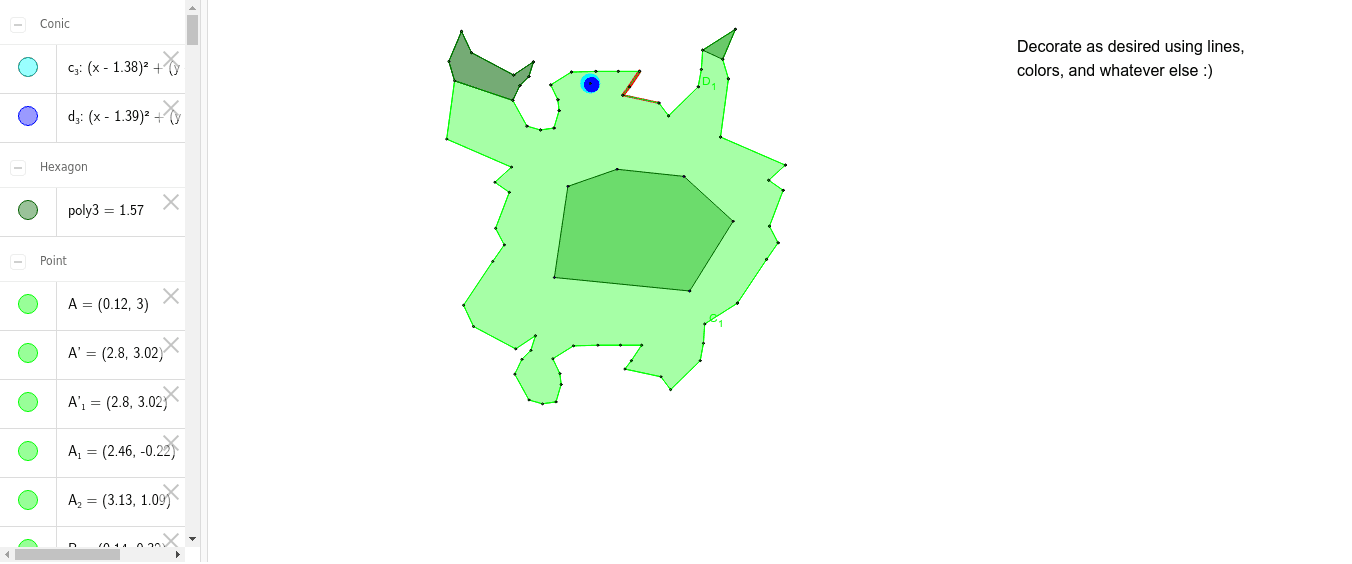
Step 7 demonstrates constructing a polygonal pyramid in GeoGebra using polygons, circles, vectors, and translations to illustrate cosine-related geometric relationships. The core concepts include polygonal geometry, vector operations, spatial transformations, the geometric interpretation of cosine, and the analysis of solid structures. The construction uses GeoGebra commands such as Polygon, Segment, Vector, Translate, and Circle, with objects like poly1, A, B, C, etc., to build the layers of the pyramid. This example is suitable for high school or early university mathematics, computer-aided geometry design, and STEM education.
GeoGebra Commands & Parameters
Polygon(A, B, 4) → poly1, a, b, c, d, C, DSegment(B, E) → eSegment(E, F) → fSegment(F, G) → gSegment(G, H) → hSegment(H, I) → iSegment(I, J) → jSegment(J, K) → kSegment(K, L) → lSegment(L, M) → mSegment(M, N) → nSegment(N, O) → pSegment(O, P) → qSegment(P, Q) → rSegment(Q, R) → sSegment(R, S) → tSegment(S, T) → a_1Segment(T, U) → b_1Segment(U, V) → c_1Segment(V, W) → d_1Segment(W, Z) → e_1Segment(Z, A_1) → f_1Segment(A_1, B_1) → g_1Segment(B_1, C_1) → h_1Segment(C_1, C) → i_1Vector(B, A) → uTranslate(B, u) → B'Translate(C, u) → C'Segment(B', C') → b'Translate(B, u) → B'_1Translate(E, u) → E'Segment(B'_1, E') → e'Translate(E, u) → E'_1Translate(F, u) → F'Segment(E'_1, F') → f'Translate(F, u) → F'_1Translate(G, u) → G'Segment(F'_1, G') → g'Translate(G, u) → G'_1Translate(H, u) → H'Segment(G'_1, H') → h'Translate(H, u) → H'_1Translate(I, u) → I'Segment(H'_1, I') → i'Translate(I, u) → I'_1Translate(J, u) → J'Segment(I'_1, J') → j'Translate(J, u) → J'_1Translate(K, u) → K'Segment(J'_1, K') → k'Translate(K, u) → K'_1Translate(L, u) → L'Segment(K'_1, L') → l'Translate(L, u) → L'_1Translate(M, u) → M'Segment(L'_1, M') → m'Translate(M, u) → M'_1Translate(N, u) → N'Segment(M'_1, N') → n'Translate(N, u) → N'_1Translate(O, u) → O'Segment(N'_1, O') → p'Translate(O, u) → O'_1Translate(P, u) → P'Segment(O'_1, P') → q'Translate(P, u) → P'_1Translate(Q, u) → Q'Segment(P'_1, Q') → r'Translate(Q, u) → Q'_1Translate(R, u) → R'Segment(Q'_1, R') → s'Translate(R, u) → R'_1Translate(S, u) → S'Segment(R'_1, S') → t'Translate(S, u) → S'_1Translate(T, u) → T'Segment(S'_1, T') → j_1Translate(T, u) → T'_1Translate(U, u) → U'Segment(T'_1, U') → k_1Translate(U, u) → U'_1Translate(V, u) → V'Segment(U'_1, V') → l_1Translate(V, u) → V'_1Translate(W, u) → W'Segment(V'_1, W') → m_1Translate(W, u) → W'_1Translate(Z, u) → Z'Segment(W'_1, Z') → n_1Translate(Z, u) → Z'_1Translate(A_1, u) → D_1Segment(Z'_1, D_1) → p_1Translate(A_1, u) → E_1Translate(B_1, u) → F_1Segment(E_1, F_1) → q_1Translate(B_1, u) → G_1Translate(C_1, u) → H_1Segment(G_1, H_1) → r_1Translate(C_1, u) → I_1Translate(C, u) → C'_1Segment(I_1, C'_1) → s_1Segment(B, J_1) → t_1Segment(J_1, K_1) → a_2Segment(K_1, L_1) → b_2Segment(L_1, M_1) → c_2Segment(M_1, N_1) → d_2Segment(N_1, O_1) → e_2Segment(O_1, P_1) → f_2Segment(P_1, Q_1) → g_2Segment(Q_1, R_1) → h_2Segment(R_1, A) → i_2Vector(A, D) → vTranslate(A, v) → A'Translate(B, v) → B'_2Segment(A', B'_2) → a'Translate(B'_1, v) → S_1Translate(B, v) → B'_3Translate(J_1, v) → U_1Segment(B'_3, U_1) → j_2Translate(J_1, v) → V_1Translate(K_1, v) → W_1Segment(V_1, W_1) → k_2Translate(K_1, v) → Z_1Translate(L_1, v) → A_2Segment(Z_1, A_2) → l_2Translate(L_1, v) → B_2Translate(M_1, v) → C_2Segment(B_2, C_2) → m_2Translate(M_1, v) → D_2Translate(N_1, v) → E_2Segment(D_2, E_2) → n_2Translate(N_1, v) → F_2Translate(O_1, v) → G_2Segment(F_2, G_2) → p_2Translate(O_1, v) → H_2Translate(P_1, v) → I_2Segment(H_2, I_2) → q_2Translate(P_1, v) → J_2Translate(Q_1, v) → K_2Segment(J_2, K_2) → r_2Translate(Q_1, v) → L_2Translate(R_1, v) → M_2Segment(L_2, M_2) → s_2Translate(R_1, v) → N_2Translate(A, v) → A'_1Segment(N_2, A'_1) → t_2Translate(u, v) → u'Translate(B', v) → B''Circle(T_1, O_2) → c_3Circle(P_2, Q_2) → d_3Segment(Q_1, J') → a_3Polygon(A, R_1, Q_1, J', I', H', G', F', E') → poly2, a_4, r_3, q_3, j'_1, i'_1, h'_1, g'_1, f'_1, e'_1Polygon(R_2, S_2, T_2, U_2, V_2, W_2) → poly3, r_4, s_3, t_3, u_2, v_2, w_2Polygon(Q_1, P_1, F, G, H, I, J, K, L, M, N, O, O_1, P, Q, R, S, T, U, V, W, Z, A_1, N_1, B_1, C_1, C, U_1, W_1, A_2, C_2, E_2, G_2, I_2, M_1, K_2, M_2, A', H_1, F_1, D_1, Z', W', V', T', L_1, S', R', Q', P', O', N', M', L', K', J', K_1, J_1, B, E) → poly4, q_4, e_3, f_3, g_3, h_3, i_3, j_4, k_4, l_4, m_4, n_4, p_3, o, p_4, q_5, r_5, s_4, t_4, u_1, v_1, w, z_1, o_1, a_5, b_4, c_4, c_5, u_3, w_1, a_6, c_6, e_4, g_4, n_3, i_4, k_5, m_5, a'_1, h_4, f_4, d_4, z', w', v', m_3, t'_1, s'_1, r'_1, q'_1, p'_1, o', n'_1, m'_1, l'_1, k'_1, l_3, j'_2, k_3, j_3, b_3Polygon(H_1, M_2, A') → poly5, a'_2, h_5, m_6Polygon(Q_1, R_1, A, E', F', G', H', I', J') → poly6, q_6, r_6, a_7, e'_2, f'_2, g'_2, h'_2, i'_2, j'_3
AI Drawing Prompt Reference
Draw a polyhedron with a quadrilateral base. The top is formed by translating vertices along a vector and connecting them. Key objects include the base polygon, translated points, and connected edges. The construction order is: draw the base polygon, determine a vector, translate the base vertices along it, then connect the translated points to form the polyhedron's sides.
The prompt above was compiled from the original drawing commands and is for reference only.