
Cube Net and Intersection Demonstration
Loading the math board and drawing, please wait…
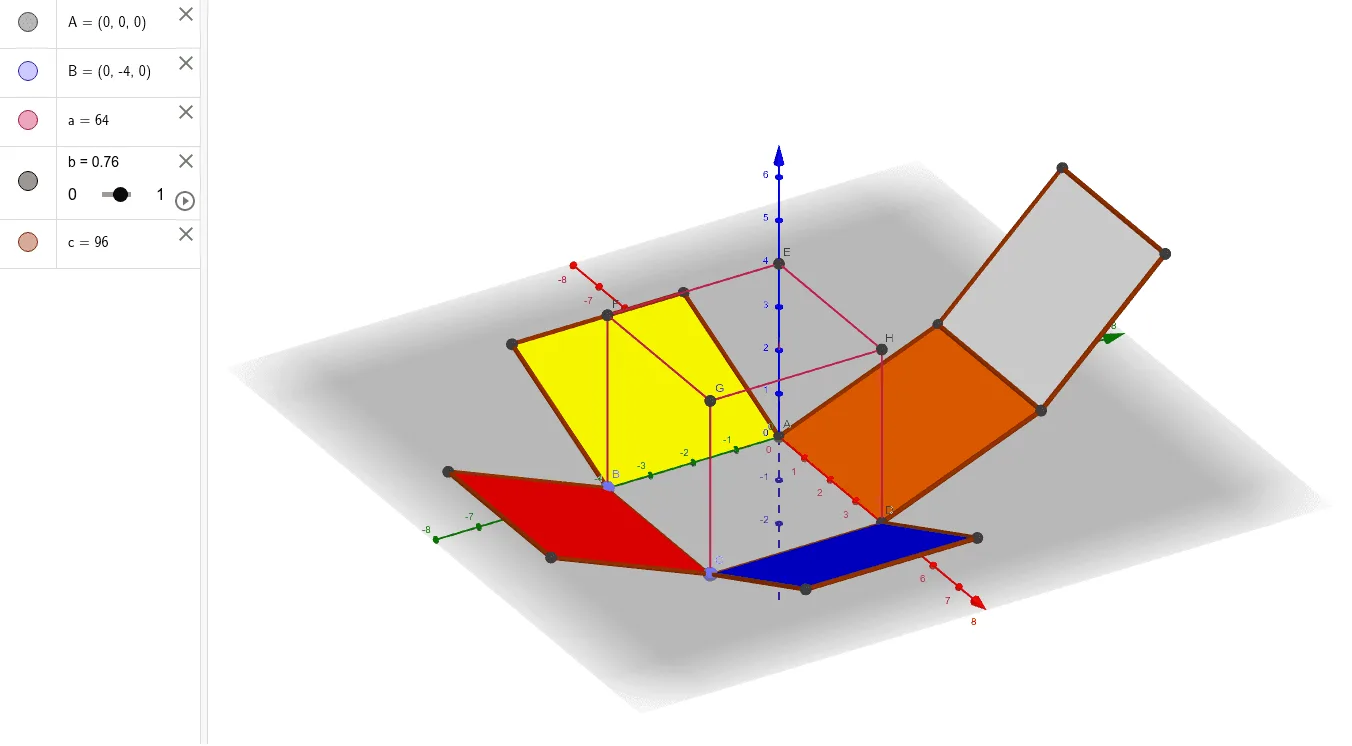
This example demonstrates the net of a cube and the intersection relationships among its vertices, edges, and faces. Core math concepts include solid geometry, polygons, intersecting lines, symmetry, and equations. Construction highlights involve using GeoGebra commands like Intersect, Point, Cube, and Net to build and analyze the geometric elements of the cube. Suitable for high school solid geometry teaching or geometric construction learning.
GeoGebra Commands & Parameters
Intersect(yAxis, xAxis) → APoint(yAxis) → BPoint(Circle[B, Distance[A, B], Segment[A, B]]) → CCube(A, B, C) → a, D, faceCDHG, faceEFGH, edgeAD, edgeAB, edgeBC, edgeCD, edgeAE, edgeDH, edgeEH, edgeEF, E, edgeBF, edgeFG, edgeCG, edgeGH, F, G, H, faceABCD, faceADHE, faceABFE, faceBCGFNet(a, b) → c, I, R, S, T, U, V, faceIJKL, faceILNM, faceIJRQ, faceJKTS, faceKLVU, J, faceMNOP, edgeIL, edgeIJ, edgeJK, edgeKL, edgeLN, edgeMN, edgeIM, edgeIQ, edgeQR, K, edgeJR, edgeJS, edgeST, edgeKT, edgeKU, edgeUV, edgeLV, edgeNO, edgeOP, edgeMP, L, M, N, O, P, Q
AI Drawing Prompt Reference
Draw a cube's net and demonstrate the intersection relationships among its vertices, edges, and faces. Start by plotting the intersection of the coordinate axes, then use this point to draw a circle to determine another vertex of the cube. Construct the cube using these three points and generate its net. Finally, label the intersections of the cube's vertices, edges, and faces, and clearly show their relationships.
The prompt above was compiled from the original drawing commands and is for reference only.