
Cube Dissection (Simple)
Loading the math board and drawing, please wait…
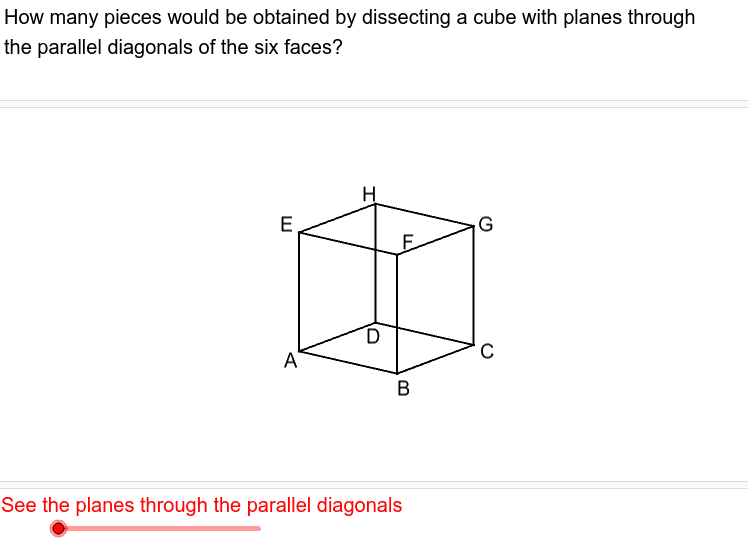
① This example demonstrates how to dissect a cube into multiple pyramids by connecting internal points, visually showing the division and recombination of a 3D solid. ② Core mathematical concepts include solid geometry (cube, pyramid, midpoint, cross-section), coordinates, variance, fractal geometry, and logarithms, with a primary focus on 3D construction and spatial relationships. ③ Construction highlights: GeoGebra commands such as Point (creating vertices), Cube (generating the cube), Polygon (drawing faces), Intersect (finding intersections), Midpoint (taking midpoints), Pyramid (constructing pyramids), If (conditional logic), and Sequence (generating series) are used; objects include the cube's six faces, twelve edges, and multiple internal pyramids (poly1, poly2, poly3, etc.), with parameters t and a controlling dissection positions. ④ Suitable for upper secondary or early university students to understand dissection principles in solid geometry, and as an introductory example for fractal geometry or spatial visualization teaching, enhancing 3D spatial reasoning.
GeoGebra Commands & Parameters
Point(Circle[B, Distance[A, B], Segment[A, B]]) → CCube(A, B, C) → a, D, faceCDHG, faceEFGH, edgeAD, edgeAB, edgeBC, edgeCD, edgeAE, edgeDH, edgeEH, edgeEF, E, edgeBF_1, edgeFG, edgeCG, edgeGH, F, G, H, faceABCD, faceADHE, faceABFE, faceBCGFPolygon(A, C, G, E) → poly1, a_1, c, g, ePolygon(B, F, H, D) → poly2, b, f, h, dPolygon(A, B, G, H) → poly3, a_2, b_1, g_1, h_1Polygon(E, F, C, D) → poly4, e_1, f_1, c_1, d_1Polygon(B, C, H, E) → poly5, b_2, c_2, h_2, e_2Intersect(d, edgeCD) → IPolygon(A, F, G, D) → poly6, a_3, f_2, g_2, d_2Midpoint(B, E) → JMidpoint(C, E) → OMidpoint(F, H) → KPyramid(J, B, F, O) → p, faceBFJ, edgeFO, faceBJO, faceBFO, faceFJO, edgeBJ, edgeBF, edgeFJ, edgeJO, edgeBOIf(t ≤ 0.8, t / 0.8, 1) → t1If(t ≥ 0.8, (t - 0.8) / 0.2, 0) → t2Sequence(Rotate[Translate[p, Vector[(t1 * u) + (t2 * v)]], (90° * k), Segment[O, J]], k, 0, 3) → list1Midpoint(C, F) → LSequence(Rotate[list1, (90° * k), Segment[O, K]], k, 1, 3) → list2Sequence(Rotate[list1, ((((2 * k) - 1) * 90))°, Segment[O, L]], k, 1, 2) → list3
AI Drawing Prompt Reference
Draw a cube and dissect it into multiple pyramids by connecting internal midpoints, visually demonstrating the division and recombination of a 3D solid. Start by constructing the cube's six faces and twelve edges, then create pyramids at the midpoints. Use rotation and sequence commands to reassemble the pyramids around the cube's center, highlighting spatial relationships and geometric construction.
The prompt above was compiled from the original drawing commands and is for reference only.