
Cube Construction and Face Analysis
Loading the math board and drawing, please wait…
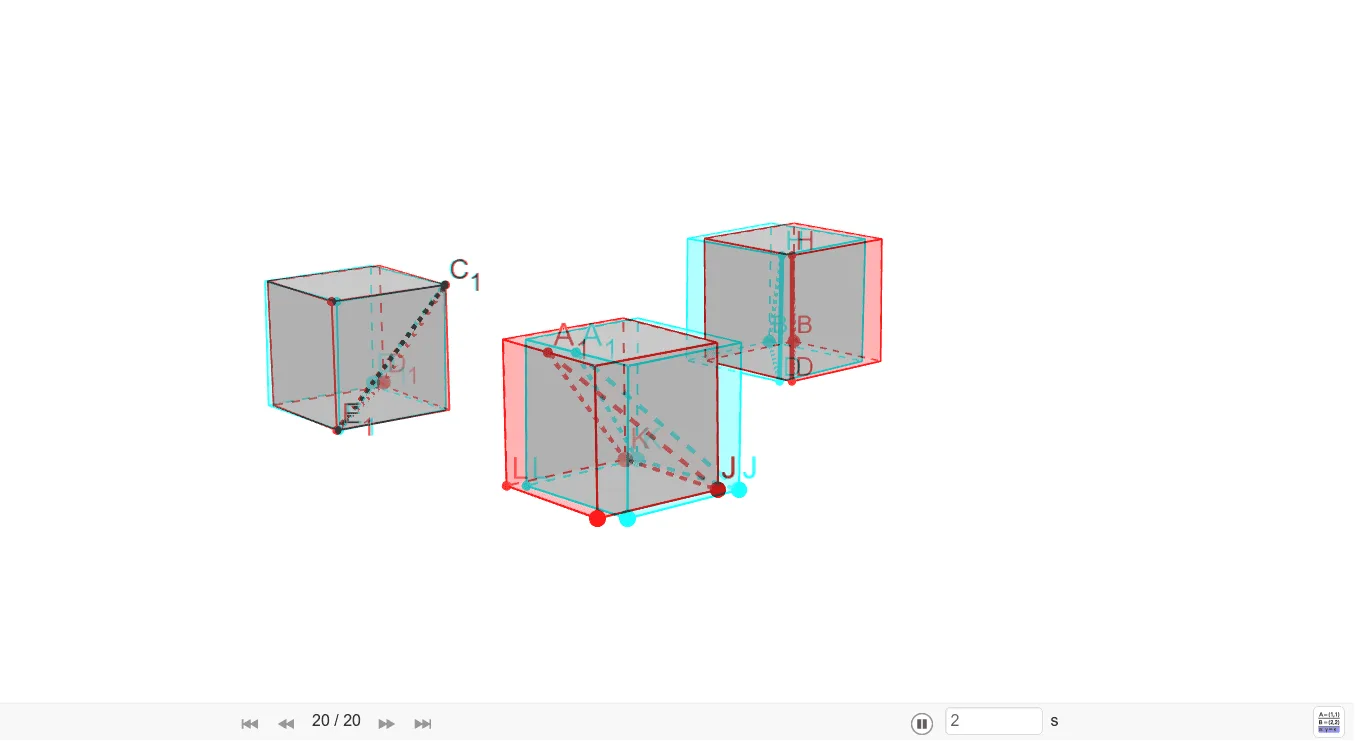
This example demonstrates the construction of a cube and analysis of its faces. Key mathematical concepts include solid geometry, surface area calculation, and spatial coordinates. Construction points include using Point, Cube, Polygon, Midpoint, and Intersect in GeoGebra to create cube objects and analyze faces and edges. Suitable for middle or high school mathematics learning to understand three-dimensional geometric structures and their applications.
GeoGebra Commands & Parameters
Point(Circle[B, Distance[A, B], Segment[A, B]]) → CCube(A, B, C) → a, D, faceCDHG, faceEFGH, edgeAD, edgeAB, edgeBC, edgeCD, edgeAE, edgeDH, edgeEH, edgeEF, E, edgeBF, edgeFG, edgeCG, edgeGH, F, G, H, faceABCD, faceADHE, faceABFE, faceBCGFPoint(Circle[J, Distance[I, J], Segment[I, J]]) → KCube(I, J, K) → b, L, faceKLPO, faceMNOP, edgeIL, edgeIJ, edgeJK, edgeKL, edgeIM, edgeLP, edgeMP, edgeMN, M, edgeJN, edgeNO, edgeKO, edgeOP, N, O, P, faceIJKL, faceILPM, faceIJNM, faceJKONPoint(Circle[R, Distance[Q, R], Segment[Q, R]]) → SCube(Q, R, S) → c, T, faceSTZW, faceUVWZ, edgeQT, edgeQR, edgeRS, edgeST, edgeQU, edgeTZ, edgeUZ, edgeUV, U, edgeRV, edgeVW, edgeSW, edgeWZ, V, W, Z, faceQRST, faceQTZU, faceQRVU, faceRSWVPolygon(H, D, B) → poly1, b_1, h, dMidpoint(M, P) → A_1Polygon(J, K, A_1) → poly2, a_1, j, kMidpoint(V, W) → B_1Intersect(edgeVW, edgeUV) → C_1Point(edgeSW) → D_1Intersect(edgeQT, edgeQU) → E_1Polygon(C_1, D_1, E_1) → poly3, e_1, c_1, d_1
AI Drawing Prompt Reference
Draw three congruent cubes positioned at different locations in space. Each cube is defined by three base points and automatically generates six faces, twelve edges, and eight vertices. In the first cube, select three vertices on a diagonal face and connect them with line segments to form a triangle. In the second cube, find the midpoint of one edge, then connect that midpoint to two vertices on the base to form a triangle. In the third cube, take the intersection point of two adjacent edges, a point on one edge, and the intersection point of another pair of adjacent edges, and connect these three points to form a triangle. The overall scene shows the three cubes with their triangular cross-sections on or inside them.
The prompt above was compiled from the original drawing commands and is for reference only.