
Creating Distances in 3 Space: Quick Formative Assessment
Loading the math board and drawing, please wait…
In collections
Creating Distances in 3 Space
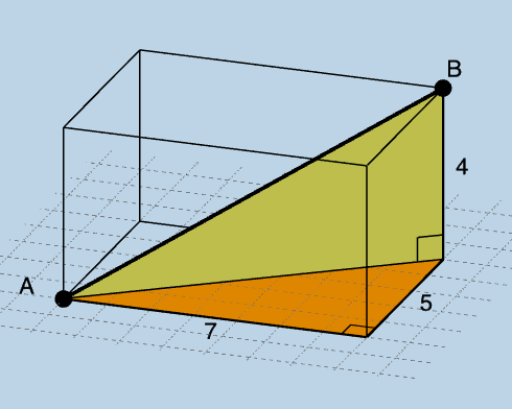
This example demonstrates constructing distances in 3D space, involving concepts such as similar triangles, trapezoids, and medians. Using GeoGebra commands like Segment, Polygon, Prism, etc., it quickly builds 3D geometric models. Suitable for middle school and above students for spatial geometry learning and assessment.
GeoGebra Commands & Parameters
Segment(A, B) → fSegment(A, C) → gSegment(C, D) → hSegment(D, B) → iSegment(D, A) → jAngle(D, C, A) → αAngle(B, D, A) → βPolygon(A, C, D, E) → q1, a, c, d, ePrism(D, C, A, E, B) → b, F, edgeCD, edgeAC, edgeAE, edgeDE, edgeBD, edgeCF, edgeAG, edgeEH, edgeBF, edgeFG, G, edgeGH, edgeBH, H, faceACDE, faceBDCF, faceACFG, faceAEHG, faceBDEH, faceBFGHPolygon(D, C, A) → t1, a_1, d_1, c_1Polygon(D, B, A) → t2, l, m, nLength(l1) → oMode(l1) → l2RandomElement(l1) → pCountIf(x ≟ p, l1) → qIf(q ≟ 1, "1 unique", q ≟ 2, "2 unique", q ≟ 3, "3 unique") → text3If(q ≟ 1, "possibility exists.", "possibilities exist.") → text4
AI Drawing Prompt Reference
Create a 3D geometric model in space using points A, B, C, D, and E. Draw the connecting segments so that the quadrilateral with vertices A, C, D, and E forms a polygonal base, and also draw the triangle defined by D, C, and A. Mark two angles at vertex D: one formed by rays DC and DA, and another formed by rays DB and DA. Then build a prism by extending the triangle (D, C, A) toward the region associated with point E, producing a 3D solid with visible triangular end faces and the corresponding rectangular/connecting side faces. Emphasize key edges and faces of this prism as a spatial geometry construction focused on distances.
The prompt above was compiled from the original drawing commands and is for reference only.