
Cosine of the Sum Angle
Loading the math board and drawing, please wait…
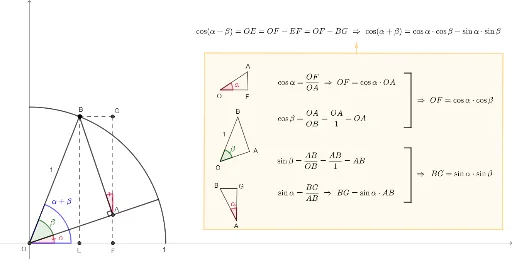
This example demonstrates the cosine of the sum angle. Using trigonometry and coordinate geometry, it shows how to calculate the cosine of a sum angle. Commands like CurveCartesian, Point, Intersect, Segment are used. Suitable for high school math education and learning.
GeoGebra Commands & Parameters
CurveCartesian(cos(t), sin(t), t, 0, π / 2) → aPoint(a) → A_1Point(a) → BIntersect(xAxis, yAxis) → OSegment(O, A_1) → fSegment(O, B) → gOrthogonalLine(B, f) → hIntersect(h, f) → AOrthogonalLine(B, xAxis) → iOrthogonalLine(A, xAxis) → jOrthogonalLine(B, j) → kIntersect(xAxis, i) → EIntersect(xAxis, j) → FIntersect(k, j) → GSegment(B, E) → lSegment(B, A) → mSegment(G, F) → nSegment(B, G) → pAngle(E, O, A) → αAngle(A, O, B) → βAngle(B, A, O) → γPolygon(C, I, H) → t1, h_1, c, dAngle(I, C, H) → δAngle(F, O, B) → εLine(L, f) → qLine(L, g) → rPoint(q) → MLine(M, m) → sIntersect(r, s) → NSegment(L, N) → tSegment(L, M) → bSegment(M, N) → eAngle(M, L, N) → ζSegment(P, Q) → f_1Segment(Q, R) → g_1Segment(S, R) → i_1Angle(G, A, B) → ηSegment(T, U) → j_1Segment(T, U) → k_1Segment(U, V) → l_1Segment(V, T) → m_1Angle(U, V, T) → θSegment(W, Z) → n_1Segment(C_1, B_1) → p_1Segment(Z, C_1) → q_1Polygon(D_1, E_1, F_1, G_1) → c1, d_1, e_1, r_1, s_1Point(d_1) → H_1Vector(H_1, I_1) → u